Jekyll2026-09-15T14:03:36+00:00https://kencaldeira.com/feed.xmlKen CaldeiraThe personal blog of Ken Caldeira: environmental science of climate, carbon, and energy.Ken CaldeiraVoting analysis for the 19th Chopin Competition2025-11-12T20:04:25+00:002025-11-12T20:04:25+00:00https://kencaldeira.com/2025/11/chopin-voting-analysis
I have thought a little about voting systems and the judges scores were made available on the Competition Web site, so I thought why not create some python code to analyze who the winners of the 19th competition under voting systems that were not used by the actual competition.
[Since the original publication of this blog post, it has come to my attention that there is a another analysis of Chopin Competition voting at https://euge.ca/chopin-2025.]
VOTING SYSTEMS
Before discussing voting systems, it is useful to take note of Nobel Prize Winner Kenneth Arrow’s impossibility theorem. I’ll let you look into it on your own, but it shows mathematically that there is no perfect voting system, that every voting system has its flaws.
This motivates my attempt to use several reasonable voting systems. If several reasonable voting systems yield the same winner, then it is likely the best winner was chosen.
[Incidentally, I was able to participate in some seminars at Stanford in which Kenneth Arrow also participated. I feel very fortunate that, in my life, I have gotten to meet, or at least be in the room with. some towering giants of accomplishment.]
In all of the voting systems considered, I take the numerical scores of each judge and then use the scores to rank the preferences across the different contestants. If two contestants receive the same score, it is assumed the judge has no preference between the two of them.
In this voting system, whoever gets the most first choice votes wins. If a judge had two people rated as first choice, that would count as 1/2 a vote for each.
Then the person receiving the most first choice votes wins (assuming there is no tie, and there was not). That person is then removed from everyone’s list, and the process is repeated to determine the second place winner, and so on to the bottom of the list.
“Copeland’s method”: Most wins on pairwise comparisons
Copeland’s method is to take the judges’ ratings of the contestants, and compare how they would be judged by each judge in a pairwise comparison, and then take the person who would do best in the most pair-wise competition.
One point is added to each contestant’s score for winning a pairwise competition as judged independently by each judge, and a point is subtracted from each contestant’s score for losing a pairwise competition. A tie neither adds nor subtracts points.
The person who has the highest point score then wins.
If there is one person who is preferred over everybody else by over half the judges, this is known as a Condorcet winner. It may not be obvious that someone can score highest on Copeland’s method without being a Condorcet winner, but it is possible. In fact, this happened in the first round of this year’s competition.
“Instant Runoff Voting”: Top-down elimination
In instant runoff voting, the candidate with fewest first preference votes is eliminated, and everyone who had that candidate as a first choice now has that candidate eliminated from their ranking so now their second choice is their first choice.
This process is iterated until some candidate gets a majority of the votes.
To determine the second place winner, the first place winner is removed from every judge’s ranking and the process is repeated. To get the third place winner, we remove the first and second place winners and repeat the process and so on.
Bottom-elimination voting
Bottom-elimination voting is the same as instant runoff voting except the process starts from the bottom instead of the top.
It is essentially repeating instant runoff voting where you flip everyone’s ranking so that the judges’ last choices are at the top and their first choices are at the bottom, and then you see who got to the lowest rankings, etc.
If instant runoff voting tries to find the candidate liked by the greatest number of judges, bottom elimination voting tries to find the candidate disliked by the fewest number of judges.
THE RESULTS
The results of this exercise can be found in an excel file located here.
Stage 1
In Stage 1, with 84 contestants, the following five contestants got the highest scores on each of the voting systems:
Table 1: Stage 1 voting results
Rank
FIrst past the post
COPELAND’s Method
INSTANT RUNOFF VOTING
BOTTOM ELIMINATION VOTING
COMPETITION METHOD
1
Kevin Chen
Kevin Chen
Kevin Chen
Kevin Chen
Kevin Chen
2
Eric Guo
Eric Guo
Xiaoyu Hu
Eric Guo
Eric Guo
3
Vincent Ong
Taianyao Lyu
Eric Guo
Eric Lu
Vincent Ong
4
Piotr Pawlak
Miyu Shindu
Vincent Ong
Miyu Shindo
Tianyao Lyu
5
Hao Rao
Shiori Kuwahara
Hao Rao
Tianyao Lyu
Shiori Kuwahara
The first thing to notice is that all of these voting systems agree that Kevin Chen won the first round. Four out of the five methods agree that Eric Guo placed second. There is reasonable cause for argument about the remaining places.
Further note that 4 out of the people top-ranked by Copeland’s method appear in the same order as chosen in the Competition. Thus it seems the Competition method is closest to Copeland’s method.
Each of these voting systems have different implications for who would be one of the 40 contestants to pass on to Stage 2.
Under the first past the post system, there were 14 people who would have passed to Stage 2 but did not (and 14 people who did pass to Stage 2 but would not have). You can look at the linked excel file to look at names.
Under Copeland’s method, there were only 2 people who would or would not have passed to Stage 2, compared to who was actually chosen to continue to Stage 2. For the instant runoff voting, there was a discrepancy of 5 people either way, and for the bottom elimination method, the discrepancy was 6 people.
By this criterion also, the Competition method seems closest to Copeland’s method.
Stage 2
In Stage 2, of the 40 contestants competing, the following five contestants got the highest scores on each of the voting systems:
Table 2: Stage 2 voting results
Rank
FIrst past the post
COPELAND’s Method
INSTANT RUNOFF VOTING
BOTTOM ELIMINATION VOTING
COMPETITION METHOD
1
William Yang
Eric Lu
Eric Lu
Eric Lu
Eric Lu
2
Kevin Chen
Kevin Chen
Kevin Chen
Kevin Chen
Kevin Chen
3
Tomoharu Ushida
William Yang
William Yang
David Khrikuli
William Yang
4
Eric Lu
Tianyou Li
Tomoharu Ushida
Shiori Kuwahara
**Shiori Kuwahara**
5
Hyuk Lee
David Khirkuli
Hyuk Lee
Piotr Alexewicz
Vincent Ong
There seems to be fairly broad agreement on the top two contestants in the second round, and arguably the third place winner.
Vincent Ong did not appear in the top five in any of the voting methods considered. Vincent came in 6th place in first past the post, 7th place in Copeland ranking, and 6th place in instant runoff voting. However, he came in 32nd place in the bottom-elimination method. This means that while there were many judges who gave Vincent Ong a high ranking, there were some who gave him a low ranking.
In terms of determining the 20 contestants to pass on to Stage 3, there were 14 discrepancies with the first past the post method, 2 discrepancies with the instant runoff voting, and 4 discrepancies with the bottom elimination voting.
For passing on to the Stage 3, Copeland’s method agreed 100% with the Competition method, providing more evidence that Copeland’s method is most similar to the Competition method in its effects.
Stage 3
In Stage 3, of the 20 contestants competing, the following five contestants got the highest scores on each of the voting systems:
Table 3: Stage 3 voting results
Rank
FIrst past the post
COPELAND’s Method
INSTANT RUNOFF VOTING
BOTTOM ELIMINATION VOTING
COMPETITION METHOD
1
Eric Lu
Eric Lu
Eric Lu
Eric Lu
Eric Lu
2
Zitong Wang
Zitong Wang
Zitong Wang
Zitong Wang
Kevin Chen
3
Kevin Chen
Tianyou Li
Kevin Chen
Kevin Chen
Zitong Wang
4
Tianyou Li
Kevin Chen
Tianyou Li
Tianyou Li
**Tianyou Li**
5
Yang (Jack) Gao
Tianyai Lyu
Yang (Jack) Gao
Shiori Kuwahara
Shiori Kuwahara
Every method agrees that Eric Lu was first place in this round, and all of the methods, except for the method actually used, predict that Zitong Wang came in second.
Interestingly, this time, the five top people chosen by the Jury were the same as the five top people chosen by the bottom-elimination method. It as if we have gone from asking who would win the most in pairwise competitions to asking who does nobody rank lowly.
In terms of the 11 contestants passing on to the Final Stage, there were 3 discrepancies with the first past the post method, 2 discrepancies with the instant runoff voting, and 2 discrepancies with the bottom elimination voting.
Once again, Copeland’s method agreed 100% with the Competition method on who should pass on to the Final Stage, providing yet more evidence that Copeland’s method is most similar to the Competition method in its effects.
Final stage
In the Final stage, of the 11 contestants competing, the following five contestants got the highest scores under each of the voting systems:
Table 4: Final Stage voting results
Rank
FIrst past the post
COPELAND’s Method
INSTANT RUNOFF VOTING
BOTTOM ELIMINATION VOTING
COMPETITION METHOD
1
Tianyao Lyu
Eric Lu
Kevin Chen
Eric Lu
Eric Lu
2
Vincent Ong
Kevin Chen
Vincent Ong
Kevin Chen
Kevin Chen
3
Kevin Chen
Piotr Alexewicz
Tianyao Lyu
Piotr Alexewicz
Zitong Wang
4
Eric Lu
Tianuao Lyu
Eric Lu
Shiori Kuwahara
Tianyao Lyu
5
Piotr Alexewicz
Vincent Ong
Shiori Kuwhara
Zitong Wang
Shiori Kuwahara
Two of the four voting methods considered here agree with the Competition method that Eric Lu was the winner, and Eric Lu appears in the top 4 under all voting systems considered.
Kevin Chen came in first on instant runoff voting, third on first past the post voting, and second with the other two methods, so the judgement of the Jury that Kevin Chen was second also seems fairly robust. (Although, the average position of Kevin Chen across the four voting systems was closer to first place than the average position of Eric Lu across the four systems.)
Zitong Wang was 7th in first past the post, 9th in Copeland ranking, and 8th in instant runoff voting. Zitong Wang seems to have made third place by not being near the bottom of anybody’s list, but he was favored by few.
Final stage, cumulative voting
I did an additional analysis where instead of considering the judges’ vote only in the Final Stage, I treated it as if there were 68 judges (4 x 17), considering all of the votes the contestants received from all of the judges in all of the rounds. I treated them as if Stage 1 Garrick Ohlsson was a different judge than Stage 2 Garrick Ohlsson. The link to the spreadsheet containing the full results of this analysis can be found here.
One could argue that it is good to take into consideration the scores from all the Stages in the final scoring, to reduce the influence of any one performance.
Under this cumulative voting approach, the following five contestants got the highest scores on each of the voting systems:
Table 5: Voting results taking into consideration votes by the judges across all stages.
Rank
FIrst past the post
COPELAND’s Method
INSTANT RUNOFF VOTING
BOTTOM ELIMINATION VOTING
COMPETITION METHOD
1
Kevin Chen
Eric Lu
Kevin Chen
Eric Lu
Eric Lu
2
Eric Lu
Kevin Chen
Eric Lu
Kevin Chen
Kevin Chen
3
Vincent Ong
Shiori Kuwahara
Vincent Ong
Shiori Kuwahara
Zitong Wang
4
Zitong Wang
Vincent Ong
Shiori Kuwahara
Tianyao Lyu
**Tianyao Lyu**
5
Tianyao Lyu
Zitong Wang
Zitong Wang
Miyu Shindo
Shiori Kuwahara
CONCLUDING COMMENTS
Copeland’s method and instant runoff voting are both typically considered relatively good voting systems, and these two voting systems would have produced different first place winners for this year’s competiton.
There is no objective way to say what would be the “best” voting system. The right voting system to use for this year’s competition was the voting system defined in the rules of the competition.
I would suggest that in future years, the Competition consider using Copeland’s method. Copeland’s method produced the results that were closest to the results obtained under the current methodology, but is a simple and widely recognized approach that has been studied in detail by mathematicians and game theorists.
Copeland’s method is not guaranteed to produce a single winner, known as a Condorcet winner. Therefore, a tiebreak procedure might be considered. A reasonable tiebreak might be to choose which of the people tied for first place under Copeland’s method does best on instant runoff voting.
Purely numerical approaches give more weight to judges who use a wide range of values in their voting, whereas methods based on ranking are less amenable to one judge having more influence than another judge.
First past the post voting is generally considered to be a bad voting system, although it is used in the UK and many other places. Bottom elimination is better at weeding out the worst than at finding the best.
Lastly, I would encourage the competition to consider developing more awards, maybe not open to the first prize winner. Who played most emotively? Who displayed the greatest technical skill? Who was the most polarizing?
I’ve been listening to Eric Lu since the Competition’s results were announced, but now I want to go back and listen to some others, realizing the “best” is a matter of taste, and even one person’s taste can differ from day to day or even hour to hour.
In particular I want to look at which contestants produced the widest divergence of opinions among the judges. Which set of judges would I agree with? And who will I like the most?
The only way to find out is to listen.
ADDENDUM
Normalized mean analysis
The above looks at ranking voting systems, but one can approach this problem numerically.
Numerical voting systems have the problem that different judges have different amount of influence on rankings depending on both their average score and how large a range they use for their scoring.
One way to adjust for this is to subtract the mean score given by each judge and divide by the standard deviation of their scores. This gives each judge the same average and the same amount of variability.
We can then rank people at each stage by this normalized mean score of the judges. A spreadsheet that does this analysis can be found here.
For the Final Stage, the results for the top 5 contestants in terms of normalized mean scores are:
Table A1: Normalized mean analysis
Rank
Contestant
Normalized Mean ± 1 STD ERROR
Normalized Standard deviation
1
Kevin Chen
0.50 ± 0.20
0.83
2
Eric Lu
0.48 ± 0.19
0.72
3
Piotr Alexewicz
0.36 ± 0.19
0.79
4
Vincent Ong
0.18 ± 0.29
1.18
5
Shiori Kuwahara
0.13 ± 0.22
0.90
There is a mathematical way to estimate the uncertainty on these scores, how much the scores would be expected to vary if you hypothetically chose a different 17 judges from the same pool of possible judges (if such a thing exists). This amount is known as “standard error”.
In my scientific work, usually results need to differ by two standard errors before we consider them statistically significant. By this measure, none of the top competitors would be considered to differ to a statistically significant degree.
I would go further and say that the Kevin Chen and Eric Lu’s scores are statistically indistinguishable.
Least agreement analysis
Above, I said it would be interesting to know which pianists created the greatest difference of opinion among the judges.
Based on normalized standard deviations as described above, in Stage 1, the contestants with the most disagreement among judges was a mix of high , mid and low ranked contestants: Xiaoyu Hu, Piotr Pawlak, Vincent Ong, Xuanyi Mao, and Gabriele Strata. In contrast, the contestants where was the most agreement were all ranked low.
In Stage 2, the contestants where there was the most disagreement were William Yang, Yang (Jack) Gao, David Khrikuli, Gabriele Strata, and Vincent Ong, who were all high to middle ranked. Most of the contestants where there was high agreement were low ranked with the exception of Eric Lu, where there was high agreement that he was very good.
In Stage 3, the most disagreement were middle to low ranked contestants: Yang (Jack) Gao, Piotr Pawlak, David Khrikuli, William Yang, and Vincent Ong. The contestants where there was the most agreement were also middle to low ranked contestant, once again with the exception of Eric Lu, where there was high agreement that he was very good.
For the Final Stage, of the people in the top five shown in Table A1, there was the most disagreement about Vincent Ong, with the highest normalized standard deviation of any contestant in the Final Stage.
It looks to me like VIncent Ong wins the prize for being considered among the top finalists despite having the most disagreement among the judges. He is who I want to listen to now. (And then Kevin Chen.)
]]>Ken CaldeiraUkraine – Fact sheet: How you can help2025-03-02T18:31:39+00:002025-03-02T18:31:39+00:00https://kencaldeira.com/2025/03/ukraine-fact-sheet-how-you-can-helpDuplicated from US State Department web site on 3 March 2025. Links to organizations under the DONATE heading have been updated.
The U.S. Agency for International Development (USAID) Ukraine crisis website.
United Nations High Commissioner for Refugees (UNHCR) website.
United Nations Children’s Fund (UNICEF) appeal to help all children in Ukraine.
DONATE
The Department has partnered with GoFundMe.org, an independent charity, to help address the humanitarian needs of the people affected by the Russian aggression against Ukraine. [NOTE: I would not trust this GoFundMe link, as it will be distributed by the current US State Department.] In addition, a variety of relief organizations are responding to the situation in Ukraine. Sending cash donations to experienced humanitarian relief organizations working on the ground is generally the most effective way to help and save the most lives. Below are organizations responding to the crisis.
The Child Mind Institute has prepared free trauma resources in Russian, Ukrainian, and English to assist parents, educators, and other adults in talking to children about traumatic events and identifying those who may benefit from professional attention.
CHILD PROTECTION PRINCIPLES IN TIMES OF EMERGENCY
We frequently receive inquiries from U.S. citizens concerned about refugee or conflict-affected children. We share these concerns for children, and we understand that some U.S. citizens want to respond by offering to adopt or host these children in need.
It can be extremely difficult during crises to determine whether children who appear to be orphans are truly eligible for adoption and immigration under U.S. laws. Children may be temporarily separated from their family, and their parents or other caregivers may be looking for them. Families may make the difficult choice to send children on their own in search of safety. Even when it can be demonstrated that a child’s parents are deceased, children are often cared for by other relatives and caregivers. During crises, many children who are not orphans temporarily live in orphanages for safety. Leaving orphanages may pose additional risks, including exploitation and abuse.
During crises, it can be exceptionally difficult to fulfill the legal and documentation requirements for intercountry adoption of both the United States and the child’s country of origin. We recommend taking extra caution when considering adopting a child during a crisis and hiring an experienced immigration attorney may also be helpful.
ADDITIONAL RESOURCES ON INTERNATIONAL STANDARDS FOR CHILDREN IN CRISES
Statement on Ukraine by Department of State’s Special Advisor for Children’s Issues
Statement on Ukraine by the Permanent Bureau of the Hague Conference on Private International Law.
UNICEF and the UN High Commissioner on Refugees joint statement on supporting children in crises.
International Social Service fact sheet with guidance on the application of international standards for children in crises.
Ukrainian authorities have jurisdiction over decisions regarding the safety and welfare of children in Ukraine, including whether to grant permission for children to exit the country. Ukrainian authorities have informed us they are moving children into Poland for safety and medical treatment. Child welfare and protection agencies that specialize in humanitarian crisis assistance, refugee issues, and family tracing are on the ground to assist and care for children who exit Ukraine.
Families who are currently in the process of adopting a child from Ukraine should direct questions and concerns to their accredited or approved Adoption Service Provider.
HOSTING PROGRAMS
Some non-governmental organizations coordinate temporary hosting programs that have included exchanges with Ukrainian children in the past. However, Ukrainian authorities have confirmed they are not approving children for participation in hosting programs at this time. The Department is therefore unable to seek approval for a child’s participation in a hosting program at this time. Please see Ukraine Adoption Update for additional information.
Although often referred to as “orphan hosting” programs, those interested in hosting should be aware that many of the children who participate in these programs are not eligible for adoption. Children who travel to the United States for hosting programs do so with the Ukrainian government’s authorization and on a U.S. non-immigrant visa. The visa is typically valid only for one entry to the United States during the narrow date range of the program. A new visa is required before travelling to the United States again.
HOSTING PROGRAMS (continued)
Previously-hosted children may apply for a nonimmigrant visa at a U.S. Embassy or Consulate outside Ukraine. However, there is no “emergency hosting” visa category, and applicants must have permission from the appropriate guardian to travel and must meet the legal criteria for an existing category of non-immigrant visa, generally a B-2 visitor visa. Applications for nonimmigrant visas are evaluated under Section 214(b) of the Immigration and Nationality Act (INA) and require an applicant to demonstrate sufficient ties to a county other than the United States that would compel departure after a temporary stay. Nonimmigrant visa applicants are “…presumed to be an immigrant until (s)he establishes to the satisfaction of the consular officer…that (s)he is entitled to nonimmigrant status…”. The presumption of immigration intent in Section 214(b) of the Immigration and Nationality Act can be difficult to overcome. Consular officers cannot issue visas based on assurances or recommendations by third parties or on the ability of a sponsor to provide financial support. Please see Visas for Ukrainian Nationals for additional information.
]]>Ken CaldeiraWhere are the abundant and reliable winds?2024-03-13T01:15:32+00:002024-03-13T01:15:32+00:00https://kencaldeira.com/2024/03/where-are-the-abundant-and-reliable-windsNorthern Europe experienced a period of very low winds in 2021, adversely impacting Europe’s ability to generate climate-friendly electricity.
This led us to ask several questions:
— Is this level of variability in wind resources consistent with historical variability, or has this variability been increasing as a result of climate change?
— Where in the world are the winds most abundant and most reliable?
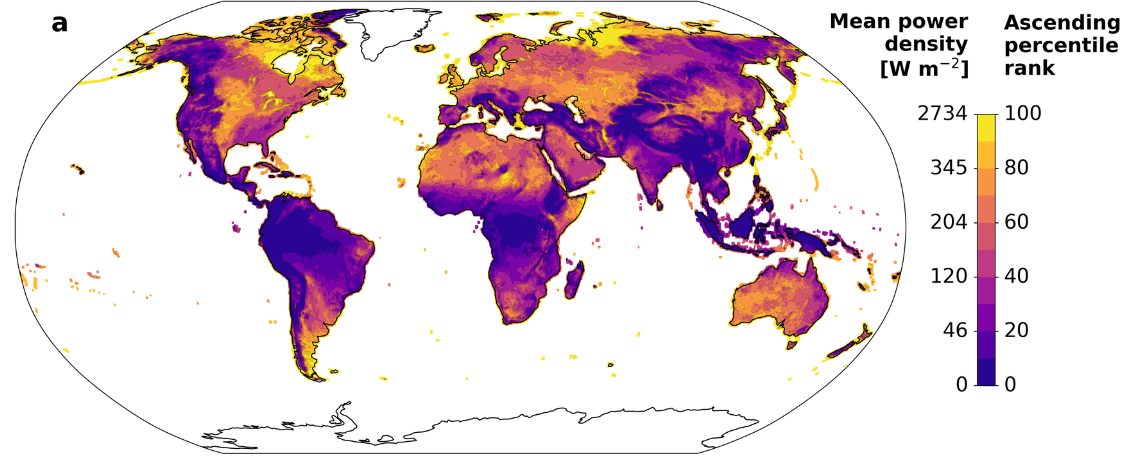
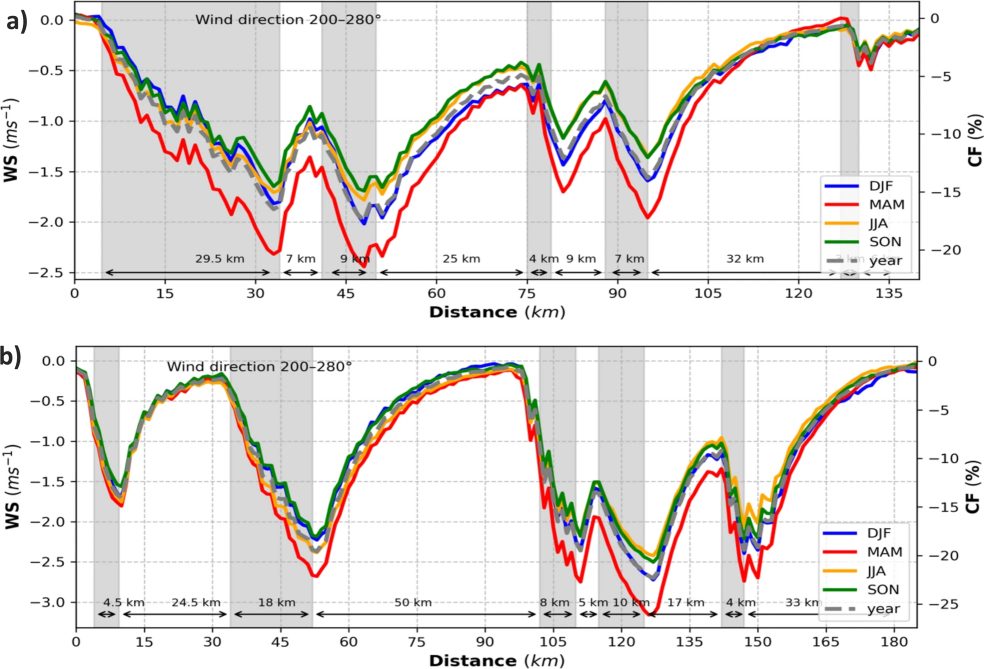
Antonini, E.G.A., Virgüez, E., Ashfaq, S. et al. Identification of reliable locations for wind power generation through a global analysis of wind droughts. Commun Earth Environ5, 103 (2024). https://doi.org/10.1038/s43247-024-01260-7
The areas in yellow above have strong winds, on average, whereas the areas in purplish colors have relatively weak winds.
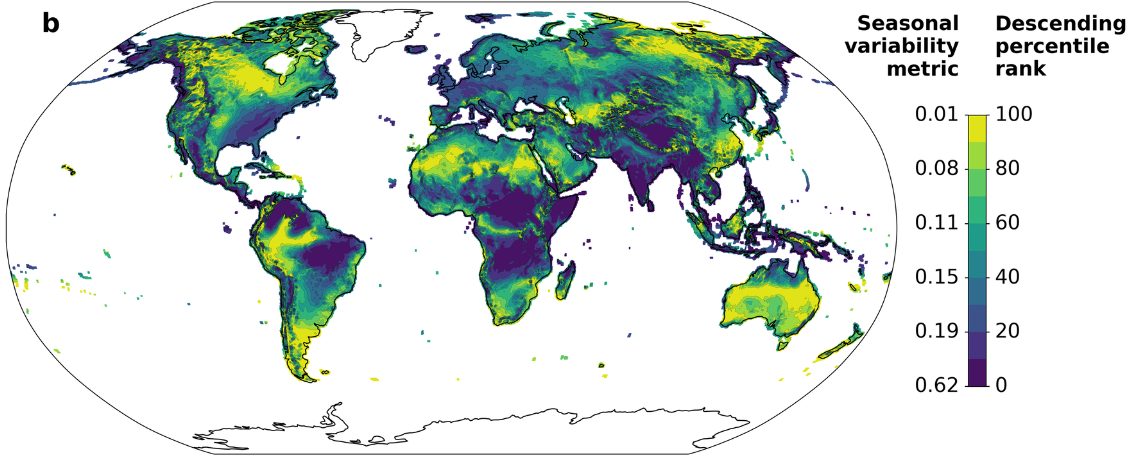
Some places can have strong winds on average, but experience a large seasonal cycle. For example, some places have more wind in the winter and others and more wind in the summer. Enrico Antonini and colleagues developed the following map illustrating the magnitude of the seasonal cycle, indicating how much the average winds shown above vary from season to season. That map looks like this:
Details of the metric and methodology are explained in the paper, and some comments on the methods are offered below. Regardless, the areas in yellow above have winds that are relatively consistent from season to season, whereas the areas in blue exhibit a high degree of variation from season to season.
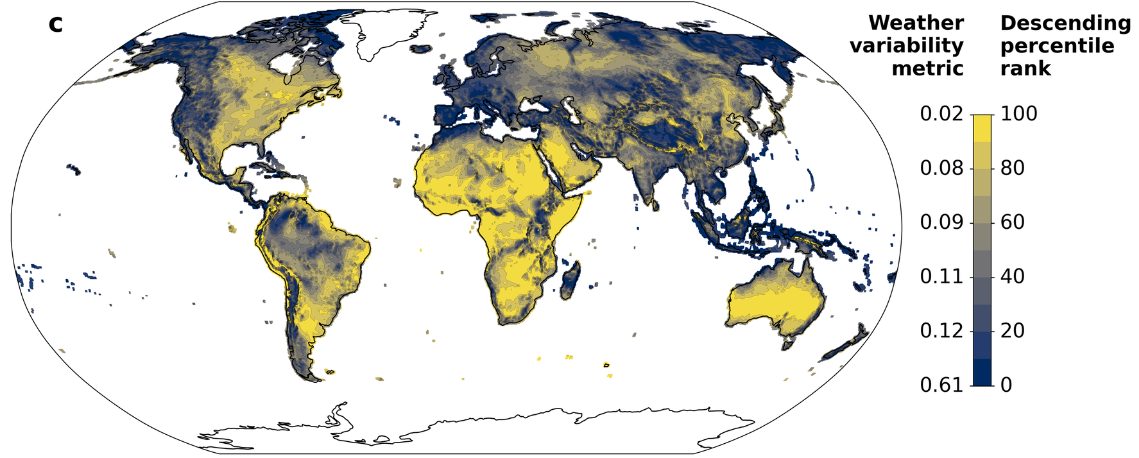
Some areas might have strong winds that are relatively consistent from season to season, but these areas might exhibit a large amount of weather variability. That is, due to weather variability, there could be weeks without much wind even if a season would typically be windy.
To estimate the degree of weather variability, Antonini and colleagues developed a metric of weather variability that indicated how much a typical year’s weather might depart from what you would expect on average. (Details in the paper, and some more discussion below.)
In the above figure, the yellow areas exhibit little weather variability, whereas in the dark area, the winds you actually get can differ markedly from what you would expect for that location and time of year.
Everyplace has its own particular needs, and certainly transmission and storage can be used to smooth out some variability in wind power production. Nevertheless, other things equal, one would like wind power that could provide a steady and reliable supply of electricity.
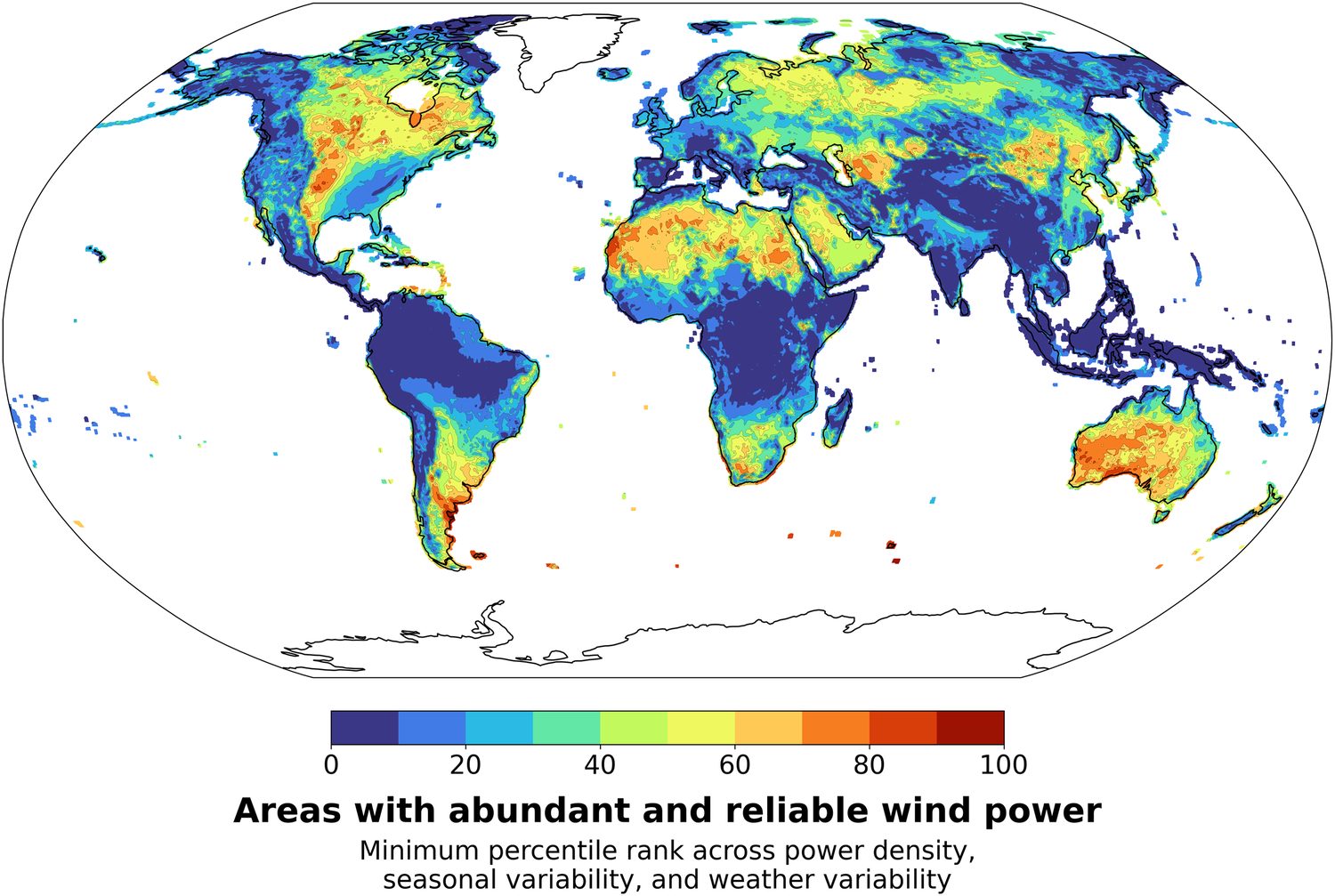
Now that we have maps of annual average wind power, seasonality of wind power, and weather variability in wind power, how do we combine these three metrics on a single map? Wind power is in units of power per square meter, whereas our variability metrics end up being in units of hours of storage that would be needed at mean demand levels. You can’t add together metrics with different units. You can multiply or divide them but that doesn’t make sense in this case.
We settled on the idea of percentile rank ordering each location from best (100th percentile) to worst (0th percentile) on each dimension, where best is highest mean power, lowest seasonal variability, and lowest weather variability. If someplace were the best on all of these metrics the minimum percentile ranking across the three metrics would be 100. If someplace were the worst on any of these metrics, the maximum across these three metrics would be zero. For someplace to have abundant and reliable winds (both with respect to seasonality and weather), the minimum percentile rankings should be high on all three metrics. We made a map based on this concept:
Places with abundant and reliable winds from Antonini et al (2024). Reds represent most abundant and reliable winds. Blue are least abundant or reliable winds.
One thing that came out of this analysis is that parts of the American Midwest are among the places in the world with most abundant and reliable winds. There are other good places in Asia, in the Sahara and southern Africa, in Australia, and Argentina.
Obviously variants of this analysis could be performed making different assumptions about storage, transmission, variation in demand and so on. We hope others will perform these analyses.
Trends in abundance and reliability
One of the things that motivated this study was the deep wind drought in Northern Europe in 2021. Are these kinds of wind drought just a product of normal variability or is there an increasing trend in wind power or its reliability that might be associated with climate change?
Before we begin this discussion, it is probably a good idea to point out a few things:
It is possible that a trend is real and driven by real underlying physical causal factors, but the trend is masked by so much variability that the trend is not showing up as statistically significant on commonly used tests.
Even if there is a trend, the trend itself could be due to natural variability or any of a large number of causes. Further, there could be a climate-induced trend that is masked by natural variability of the opposite sign.
In short, our tests of statistical significance do not lead to any determinative claim for causality in any direction. Absence of evidence is not evidence of absence.
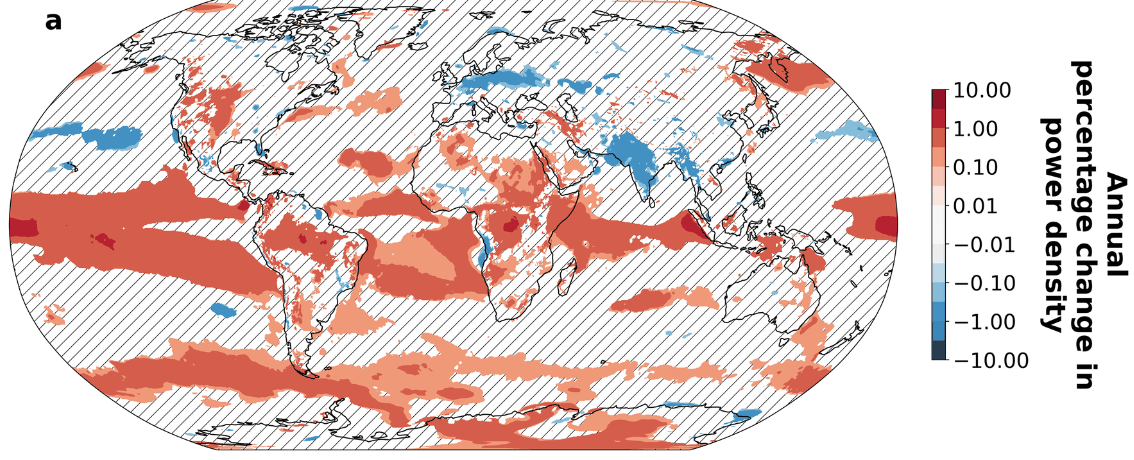
When we look for trends in annual mean wind speeds over the period from 1979 through 2022, we get a map that looks like this:
Trends in mean wind power from Antonini et al (2024). Reds represent stronger winds, blues represent weaker winds. Hatched lines indicate trends are not significant at the 0.05 level.
From the above figure we see that winds tend to be getting stronger in the equatorial region and in parts of the Southern Ocean. I am somewhat hesitant to ascribe too much significance to trends observed over land because we would expect 5% of the land area to show up as statistically significant at the 0.05 level just by chance. Nevertheless, there is an indication of a strengthening of winds in parts of the American Midwest and a weakening of wind over Northern Europe and India.
More investigation is needed to determine if these trends are real, and if so, whether climate change is an important causal factor.
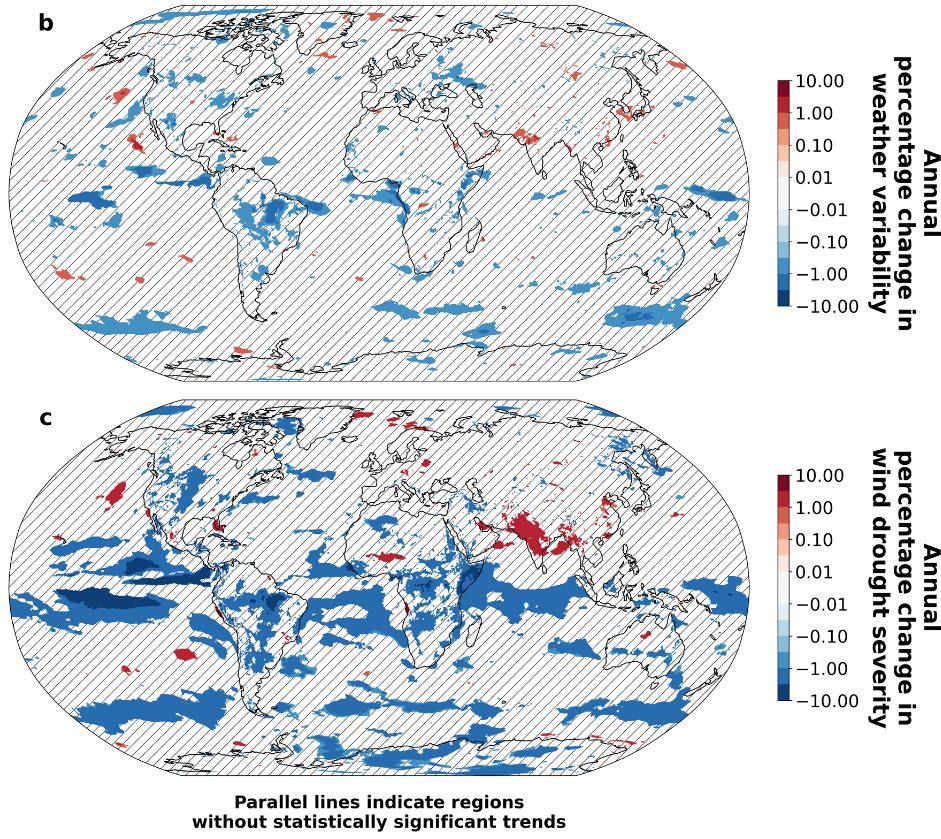
Trends in weather variability in winds and wind drought severity from Antonini et al (2024).
We found very little evidence of trends in weather variability in wind power. However, winds seem to be strengthening in the American Midwest and weakening over much of India. The result is that wind droughts, according to the metric we discuss below, are becoming less severe in the American Midwest and more severe over parts of India.
Energy metric of wind drought
There have been previous studies of wind drought (periods of low wind) that use arbitrary cut-offs of different sorts, such as how low the winds need to fall, or how long the low winds need to last, to be considered a wind drought.
Sometimes there can be an extended period of low winds that is interrupted by a single windy day or windy hour. Or there can be an extended period of relatively low winds but no time when the winds are extremely low. We wanted to develop a metric that could handle all of these cases in a consistent way.
We discuss wind droughts in terms of an energy deficit relative to some background case. For example, imagine we want to characterize the amplitude of the seasonal cycle in winds. We could ask: If we had this annual cycle repeating, how much energy storage would we need to yield a constant output of energy at the annual mean rate?
If the winds were steady, you would need no storage. If the winds were 8760 times the mean for 1 hour and then zero for the rest of the year, you would need an amount of storage nearly equal to the entire annual wind output. Intermediate cases would need intermediate amounts of storage.
To estimate weather variability relative to seasonal averages, we construct a year where wind power follows the typical average profile for different times of the year, and then we ask how much storage would be needed to offset weather variability and provide the amount of power from climatologically expected winds.
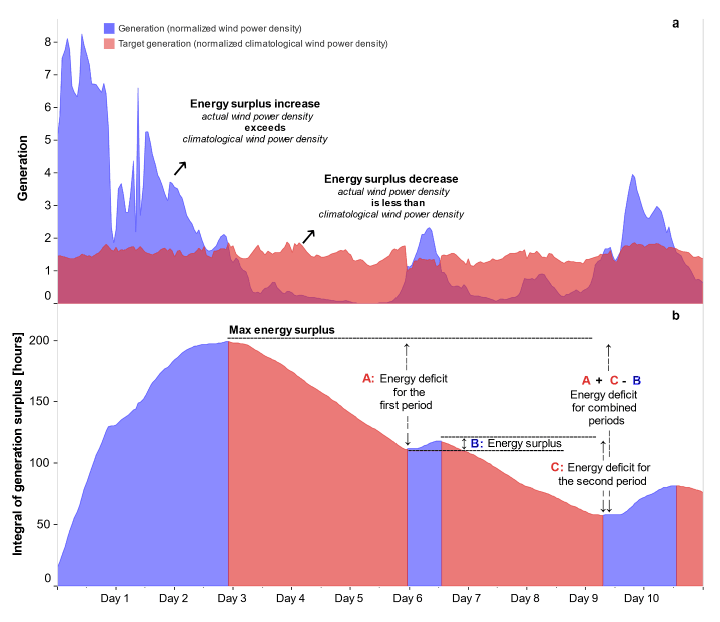
The figure below illustrates this methodology for a more realistic case, where the blue curve in panel a represents wind generation and the red curve represents the required output. When the blue curve is greater than the red curve, excess power is available and the power could be thought of as adding to storage. When the red curve is greater than the curve, that means the wind energy in insufficient to meet the target and so energy must come out of storage.
Note that the illustrated period of energy deficit is interrupted by a brief period of excess generation on Day 6. However, the amount of storage that would be needed to make up for the energy deficit would be the sum of the two areas where the red is above the blue from Day 3 to Day 10, less the excess generation that occurred on Day 6.
The amount of storage needed by calculating the difference in energy between each local minimum in the integral of generation minus target and the preceding global maximum in this integral (as illustrated in panel b).
Illustration of the process to calculate the energy deficit metric. Panel a shows a representative time period of 11 days with the actual wind power density time series (in blue) and the target climatological wind power time series (in red). In the same panel, we indicate regions of energy surplus and deficit. Panel b shows instead the integral of the energy surplus resulting from the difference between the actual and target generation. Our energy deficit metric is the largest energy deficit present in the generation balance integral over the period under consideration (in the panel indicated as A+C ̶ B). From the Supplementary Material to Antonini et al. (2024).
I am very much proud of this paper. I think Enrico Antonini did a fine job pulling all of this together. I also thank our co-authors who each helped in various ways.
In our group, we like to do geophysical studies that are relevant to energy systems. We chose steady power because we wanted this to be a geophysically-oriented study focused on basic principles and methodology. Our computer codes are publicly available and ready to be modified for specific applications.
It would have been easy for us to incorporate costs of turbines, and real electricity demand curves, and consider inefficiencies and costs of batteries and so on. Consideration of transmission would be a bit more challenging but could be done. However, a study like this that is purely geophysical will stand the test of time.
Studies that consider more things like real demand profiles, technical characteristics, and costs are very valuable, but will tend to age as these properties change over time. Studies could also consider mixes of wind and solar and perhaps other generation sources. We encourage others to do such studies. We may end up doing some of these studies ourselves.
Of course, we do not expect people to decide whether or not to build wind farms based on our study alone. However, we hope that our study provides incentive for people to look more carefully at the potential for wind power in areas that we have identified as having abundant and reliable wind resources.
The Green Premium is the difference in cost between a technology that reduces net greenhouse gas emissions and the cost of the currently-used greenhouse gas-emitting technology.
The Abstract of this paper provides a good overall summary of what we did and our findings. In this blog post, I want to highlight a few things that we have found in doing this investigation.
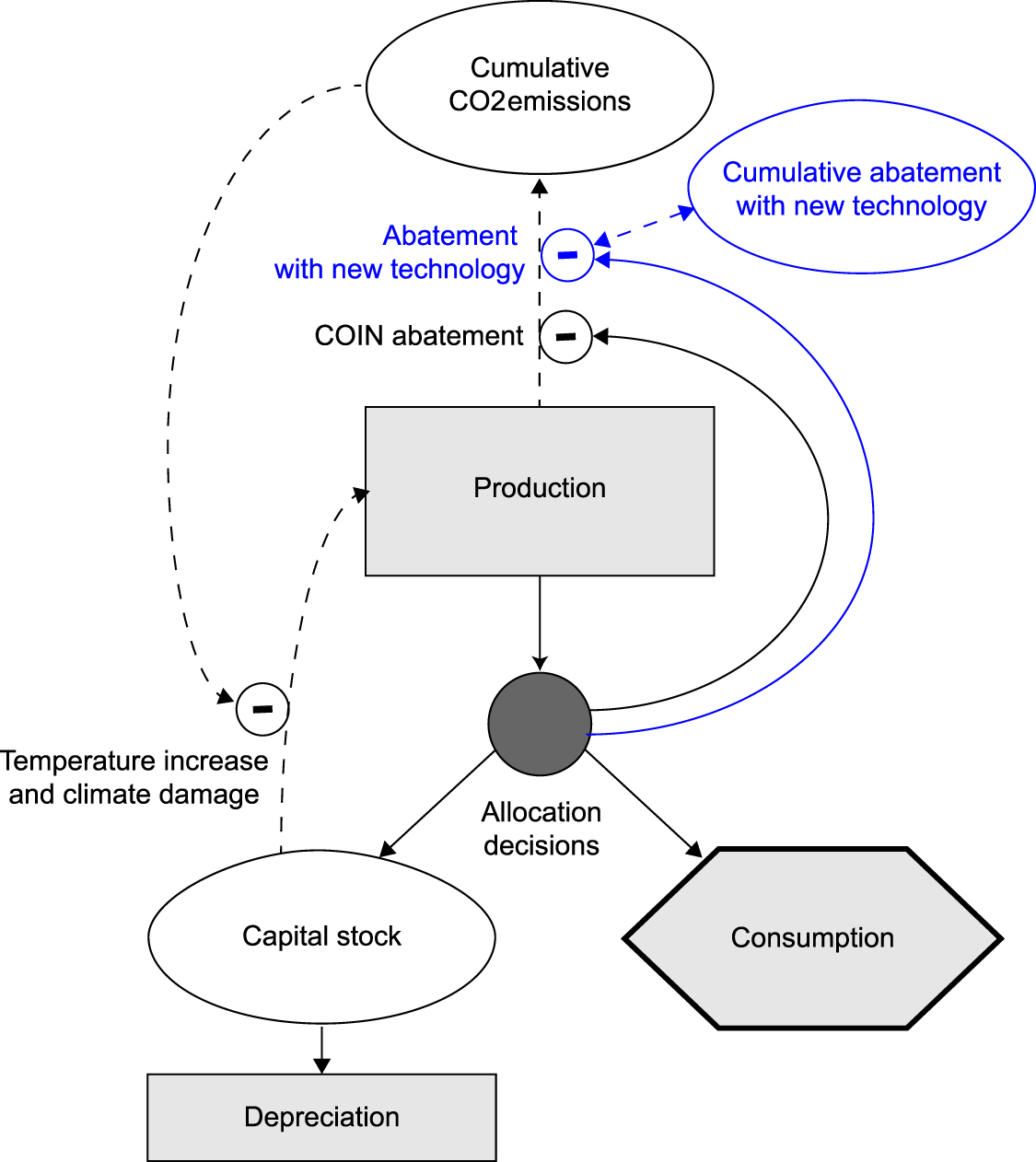
The idea for this model came in the discussion after I gave a talk for University of Waterloo on 3 Dec 2020. We wanted to have a model that was simpler than Nordhaus’s DICE model. We called it the COIN model, laughing that it was simpler than the DICE model — only two sides instead of six.
The COIN model is designed as a tool that can be used to explore conceptual issues, and to teach about climate change economics. It is not intended to produce numerically accurate results.
Among other simplifications, in the COIN model, the amount of warming is proportional to cumulative carbon emissions, climate damage is assumed to scale with the square of temperature change, population is held constant, and total factor productivity is assumed to increase exponentially with time.
For this paper, we added a second abatement technology to the COIN model with costs that followed an “experience curve” (also known as a “learning curve”). The optimizer was allowed to choose to invest in the new technology, even when it was more costly than the incumbent technology.
Stringency of carbon constraint
Sometimes people say things like, “We don’t have time to develop new technologies. We just have to deploy the technologies we already have.”
It is certainly true that we need to deploy the technologies that we already have, but it doesn’t follow from that that we should not put effort into developing new technologies or reducing the cost of existing technologies.
The idea that there is not enough time to develop new technologies or improve existing technologies is based on a mistaken notion. We can develop what does not exist while we deploy what does exist.
We found that the value of reducing the Green Premium increases with the stringency of carbon constraint. If we want to ramp down to zero net emissions by year 2050, there is even more value to reducing the Green Premium than if we were to, say, ramp down to zero net emissions by year 2100.
Rapidly decreasing emissions requires building a lot of costly infrastructure. Because of the way returns on investments and economic discounting works, you would need to invest more today to build something in year 2050 than you would to build the same thing in year 2100. If we have more ambitious climate goals, it becomes even more valuable to reduce technology costs.
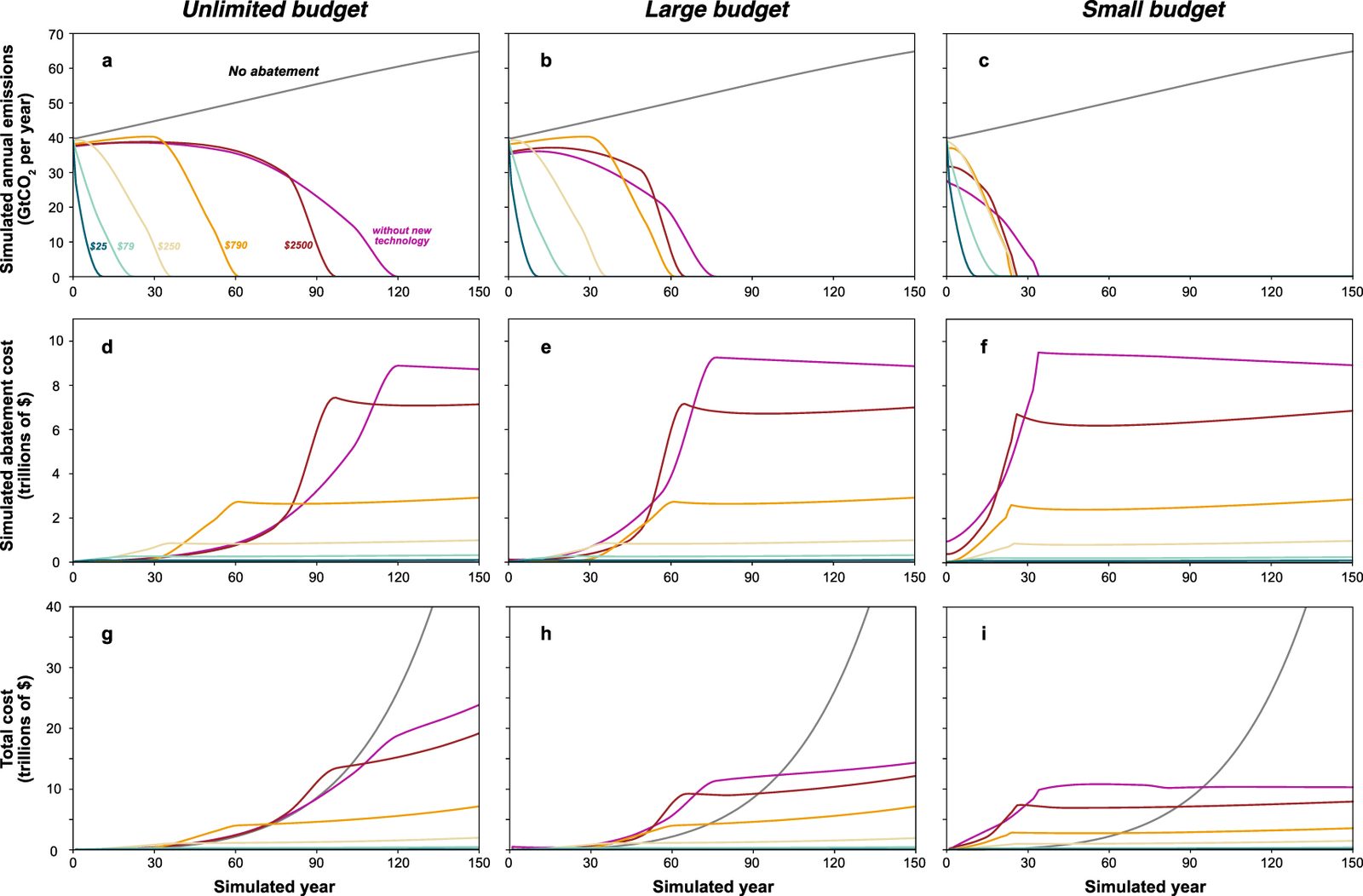
Figure 3. Impact of cost-saving innovation on (a)–(c) simulated annual emissions, (d)–(f) abatement cost, and (g)–(i) total cost (abatement cost plus climate damages). Initial cost of the new abatement technology with learning is directly reduced to various levels while preserving the learning rate, which represents the impact of cost-saving innovations from research & development (R&D). In all three scenarios, lower initial technology costs reduce overall climate damages and costs of abatement efforts. Lower initial technology costs also incent more temporary emissions in earlier years as future carbon abatement becomes cheaper.
Costs don’t stop when we reach net-zero emissions
In Figure 3 (above), the middle row of panels is the cost of emissions abatement. Columns are different levels of abatement stringency. Note that the cost of mitigation abatement remains high in these simulations, even after all emissions are eliminated.
Sometimes people act like all of the cost of zero net emissions is in the transition to zero net emissions, but to maintain zero net emissions can also be costly if we do not have low-cost technologies available to help us avoid emissions.
One of the key benefits of reducing the Green Premium is to reduce costs after we have already achieved net zero emissions.
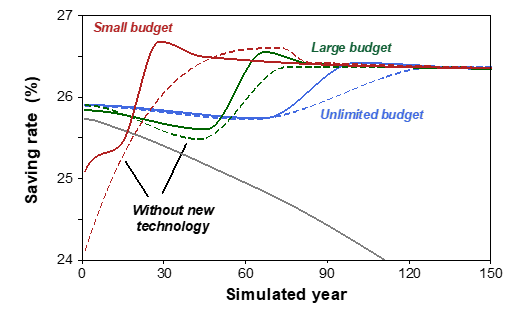
Figure S5. Simulated saving rates under No abatement, Unlimited budget, Large budget, and Small budget scenarios. The black line above is the savings rate in the absence of climate change mitigation (“no mitigation”). This is Figure S5 from the “Supplementary Data” from our paper.
Do investments in emission reduction come from current consumption or from other capital investment?
I didn’t know the answer to the title of this section. If investment in mitigation cannibalized other forms of capital investment this could slow economic growth, yielding knock-on costs to the economy.
A basic insight is that if you think the world is going to end tomorrow, there is little incentive to invest in the future.
However, in our model, investing in emissions reduction produces a better future, with less climate damage. This is especially true as the Green Premium is decreased.
Climate damage, and the cost of mitigation, can be thought of as akin to taxes, and expectation of lower future taxes provides an incentive for increased investment.
Thus, in our model, the capital for investment in mitigation comes from current consumption. In contrast, investment in other forms of capital (the “savings rate”) increases relative to the “no mitigation” case.
Figure 1. Diagram of the version of the COIN (Climate Optimized Investment) model used in this study. There are three state variables in this mode of the model: capital stock, cumulative carbon emissions, and cumulative emission abatement with a hypothetical new technology with a learning curve.
Learning subsidies
The COIN model uses an optimizer to determine the optimal partitioning of resources between consumption, capital investment, investment in abatement using the incumbent mitigation technologies (“COIN abatement”), and investment in abatement with a new technology with costs that decline following an “experience curve” (also known as a “learning curve”).
In Nordhaus’s DICE model, the marginal cost of abatement is equal to the marginal net-present-value of climate damage avoided. However, we find that in nearly all cases considered, the optimizer is willing to pay more for the new technology, because there is value in driving the new technology down the learning curve. This additional investment in the more costly technology is known as the “learning subsidy” (or “learning investment”).
We found it very interesting that the optimizer, in nearly all cases, was willing to pay a learning subsidy to help drive the new technology down the learning curve. This suggests that subsidies for new clean technologies can be an economically efficient way to produce a better future.
Summary
We have developed an extremely simple model, the COIN model, to investigate conceptual issues related to the economics of climate change mitigation in general, and the value of decreasing the Green Premium in particular.
We have found that there is substantial value in reducing the Green Premium, and the more stringent the climate goals, the greater the value of decreasing the Green Premium.
In our simulations, much of the value of developing cheaper abatement technologies accrued after net-zero targets were reached. Decreasing Green Premiums not only makes it easier to get to net-zero, it makes it cheaper to stay there.
In nearly every case considered, the optimizer chose to invest in a learning subsidy to bring down the cost of the new technology, even as it allocated substantial resources to deploy existing technologies. This suggests that it can be economically efficient to subsidize new technologies that are proceeding down a learning curve.
In our simulations, investment in emissions abatement induced higher rates of capital investment in other parts of the economy. Decreased costs of emissions abatement and climate damage are akin to expectations of lower future taxes, and expectations of lower future taxes, in an efficient economy, induce increased capital investment.
Lastly, I would like to close with a bit of homage to simple conceptual models. We do not pretend that our model provides reliable numerical results, but we do believe that our model provides conceptual insight that is applicable to the real world.
Reducing the Green Premium can contribute to achieving climate goals, and helps us to develop a better future.
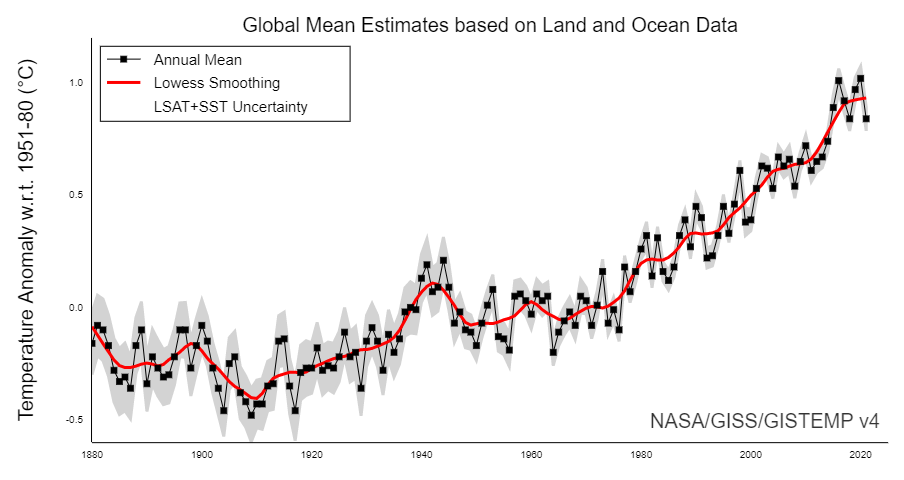
]]>Ken CaldeiraMulti-decadal country-level regressions on GDP growth and temperature change2022-11-09T12:56:34+00:002022-11-09T12:56:34+00:00https://kencaldeira.com/2022/11/multi-decadal-country-level-regressions-on-gdp-growth-and-temperature-changeOver the past 50 years, the world has seen a substantial amount of global warming,
Global mean temperature change. https://data.giss.nasa.gov/gistemp/graphs_v4/
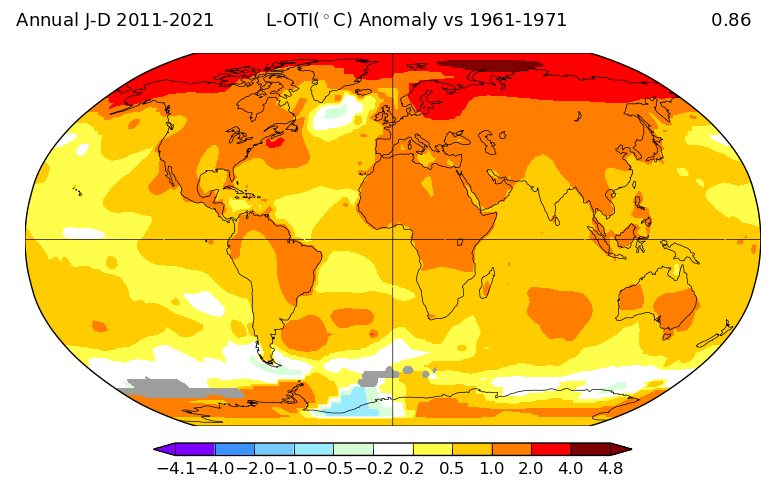
And there has been substantial regional variability in the rate of warming.
These observations led us (Lei Duan and myself) to ask whether there was a statistically significant relationship between country-level rates of warming and rates of GDP growth over the past half century.
We used country-level temperature change data from Berkeley Earth, kindly provided to us by Zeke Hausfather. We used GDP data in 2015 USD from the World Bank. For population, we used data from NASA’s SEDAC. We focus on the 50-year time period from 1971 to 2020, and include only countries that had data for the full 50 years. We performed country-level linear regressions, weighting countries in three different ways: (1) countries weighted equally; (2) countries weighted by GDP; and (3) countries weighted by population.
For each country, we estimated an average rate of temperature increase with a ordinary least-squares regression of country-level annual mean temperature versus time; estimated an average continuous rate of GDP increase with an ordinary least-squares regression of the logarithm of country-level annual GDP versus time. We report results for temperature increase in units of K/yr and for GDP growth rates in units of %/yr.
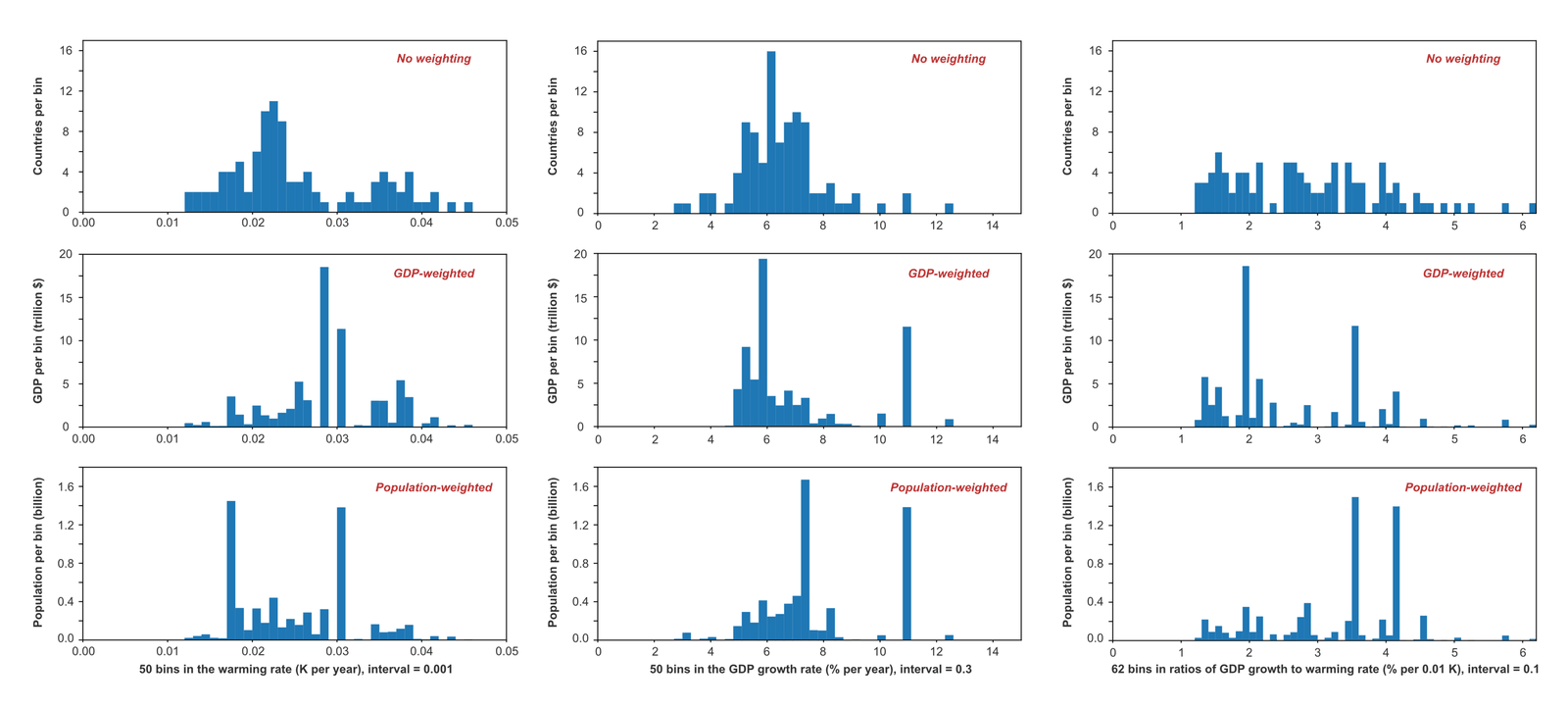
If for each country, we divide the GDP growth rate trend by the temperature rate trend, we get a slope in units of %GDP/yr per K/yr or, equivalently, %GDP/K. The histograms for the country level warming rates, GDP growth rates, and ratios of GDP growth to rates of warming looks like this:
Histogram showing the distribution of mean warming rates, GDP growth rates, and the ratios of these two rates. The top row weighs each country equally; the second row weighs countries by GDP; the third row weighs countries by populations.
The simple point of the above figure is to illustrate that every country has experienced a warming trend over the past half century, and every country has experienced positive GDP growth.
The ratio of GDP growth to warming rate has therefore been positive in every country. This is a reminder that there are many factors that influence GDP growth. Temperature increases may have slowed GDP growth in many countries but climate change has not been the primary determinant of GDP growth.
To investigate whether, on the half-century scale, there are robust relationships between country-level rates of warming and country-level rates of GDP growth, we performed linear regressions of each country’s GDP growth rate against its rate of warming, with those rates determined as described above.
Because countries are not normally distributed in their properties, we estimated uncertainties in the regression by using a bootstrap approach — doing 2,000 regressions sampling from our data by choosing countries for randomly from the set of complete countries, with replacement.
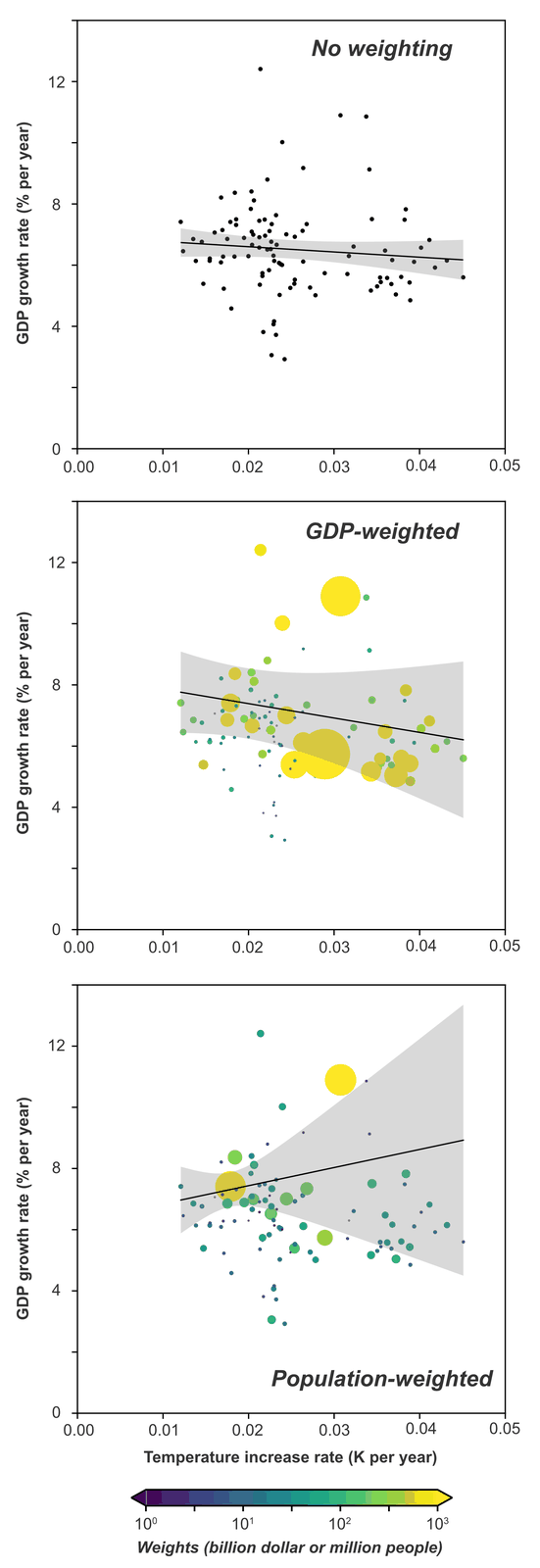
Our primary results are displayed in this figure:
Regression of GDP growth rate against rate of temperature change. The solid line is the regression on the raw data. The shaded area is the area that incudes 95% of the bootstrap simulations drawing on countries randomly with replacement.
Note that a horizontal line would be consistent with the 95% uncertainty range for all three country weightings. Our conclusion from this preliminary analysis was that there are too many other things affecting country-level GDP growth over the past 50 years for a climate signal to show up strongly in a global regression on annual-mean country-level temperature and GDP data.
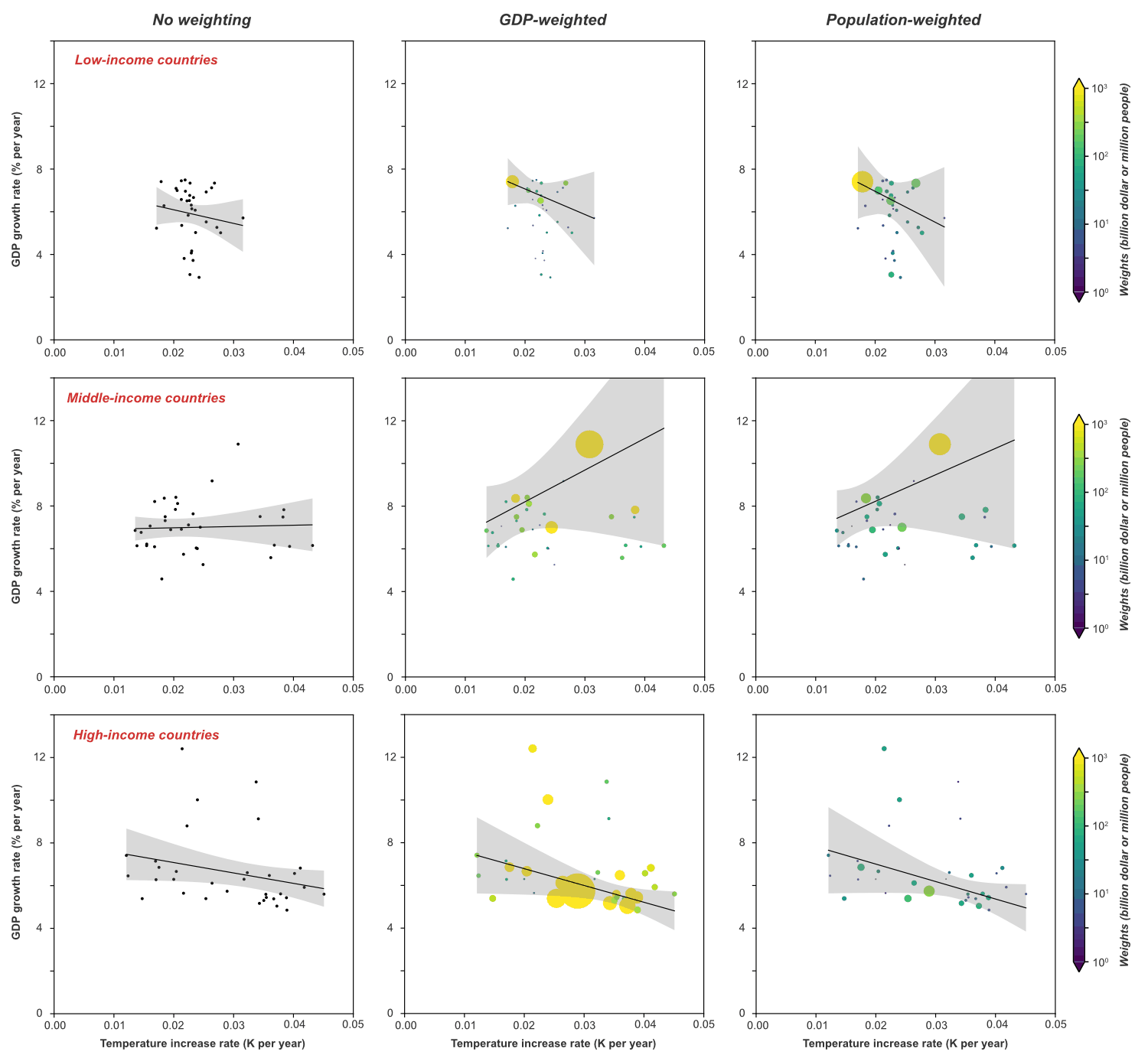
The next thing we did was to look at whether there were differential impacts based on the GDP of the countries, so we stratified countries into three income groups with approximately equal number of countries in each group. There may be some indication of negative climate impact on GDP growth in the low- and high-income countries, but not at a level that would permit publication in a high-quality journal.
Regressions of GDP against temperature for high, middle, and low income countries, with countries weighted equally, by GDP, or by population.
Regressions in the low-income countries are strongly influenced by India, which experienced both relatively modest warming and relatively high rates of GDP growth. Regressions in the middle-income countries are strongly influenced by China, which experienced both substantial warming and very high rates of GDP growth.
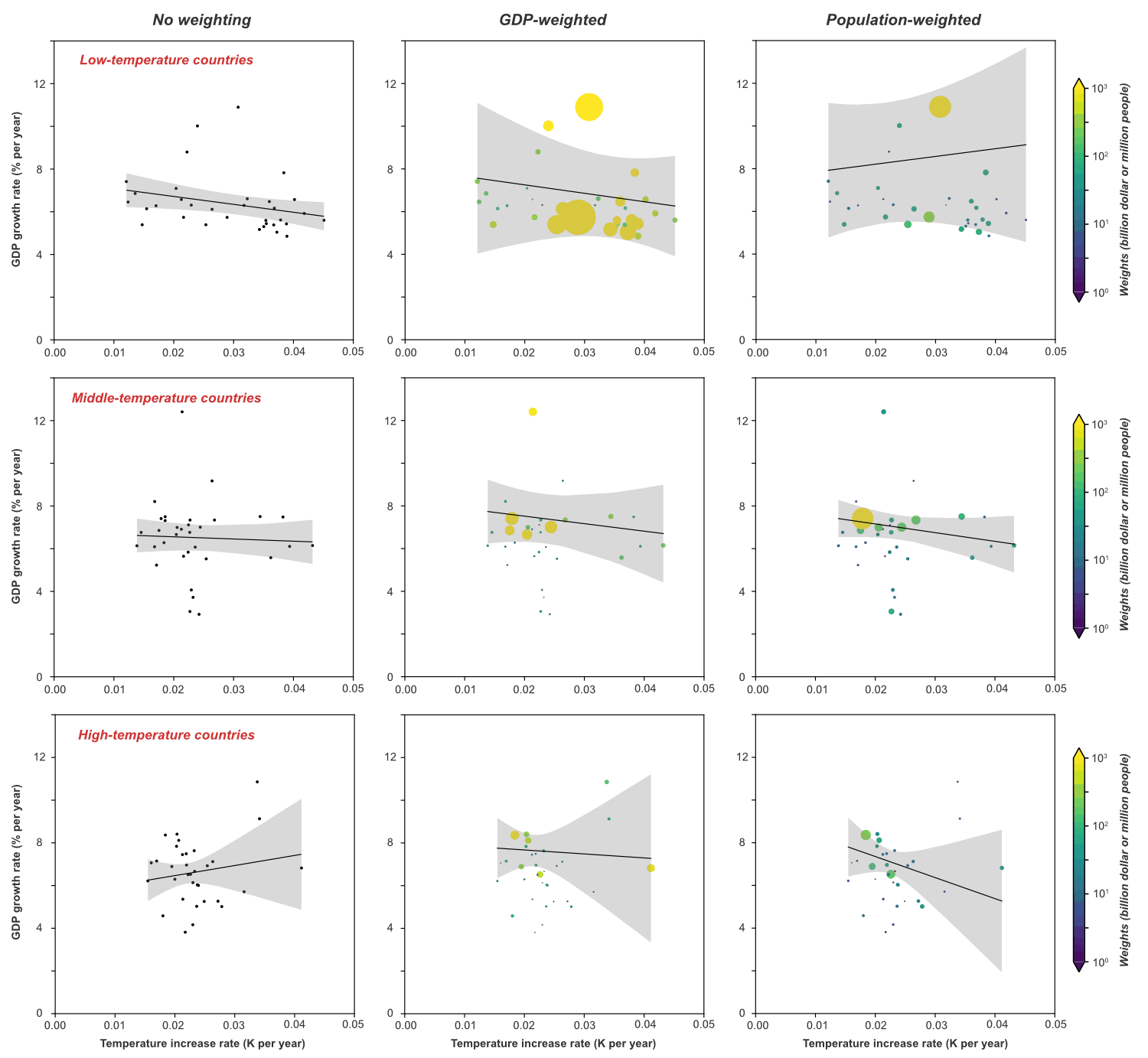
Some climate damage functions predict net benefits of global warming for cold countries and net harm for warm countries. Therefore, we did an analysis partitioning countries into three groups based on mean country-level temperature. The result of those regressions appear in the next figure:
Regressions of GDP growth against temperature for low, middle and high temperature countries, with countries weighted equally, by GDP, or by population.
Again, we do not see strong trends. One might project that warming would have the strongest negative influence in the highest-temperature countries, but no strong signal emerges from this data. The signal of climate damage, if it is there, appears to be overwhelmed by other factors that influence rates of GDP growth.
We understand that there are many things we could have done to try to account for other sources of variability with the aim of isolating the effects of climate change as a residual. However, after consideration, we decided this was not a good application of our time.
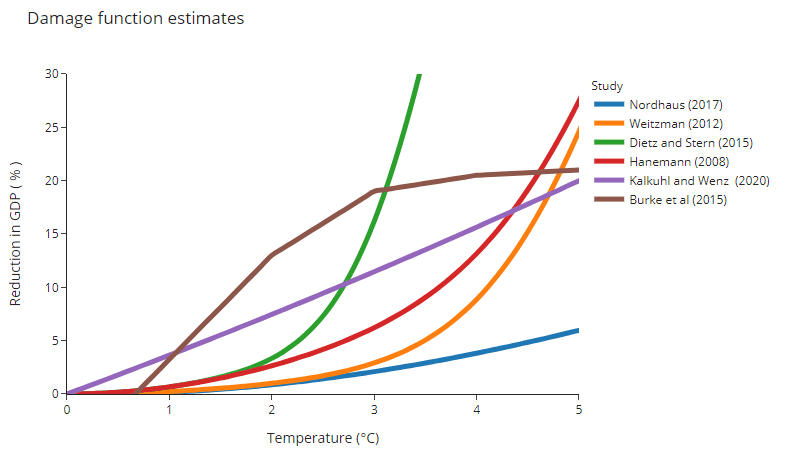
It is possible that future climate change might produce a large amount of damage even if historical climate change did not cause a lot of damage. (It should be noted that there are a number of studies identifying historical climate damage, for example Callahan and Mankin [2022].) Many so-called “climate damage functions” do not show substantial climate damage below 1 C of warming but then show substantial climate damage at higher warming levels.
We thought about preparing this analysis for peer-reviewed publication, but the basic conclusion is that there are many factors that affect GDP growth, and that without considering those factors it is difficult to discern a signal of multi-decadal warming trends on multi-decadal GDP growth .
In closing, I would like to remind people that I have spent most of my professional life working on better understanding climate change and helping to facilitate a transition to a global economy that does not rely on using the atmosphere and oceans as waste dumps for our CO2 pollution.
Our analysis comparing half-century trends in temperature change with half-century trends in GDP growth for the period 1971-2020 did not provide strong evidence for a relationship between these two parameters. However, our uncertainty range is so large that our analysis does not serve to exclude a very strong historical relationship between temperature change and GDP growth. Our failure to provide compelling evidence for this relationship is not evidence that this relationship does not exist.
NOTE: The calculations and figures presented here were done by Lei Duan, working interactively with me.
ALSO NOTE: Others, including Richard Newell and colleagues, have done more sophisticated analyses addressing this issue.
]]>Ken CaldeiraA ban on solar-geoengineering research?2022-01-21T10:09:59+00:002022-01-21T10:09:59+00:00https://kencaldeira.com/2022/01/a-ban-on-solar-geoengineering-researchA colleague asked me about whether I would sign on to an effort that would effectively ban most research on solar geoengineering. Here is a lightly edited response.
A few points:
1. The main problem with this letter is that it is an assault on freedom of research that is in-itself benign.
I don’t see that banning outdoor research on solar geoengineering is different in kind from the Catholic Church banning Galileo from dropping balls off the leaning tower of Pisa.
There should be a presumption that if an experiment is expected to lead to negligible direct harm, that the experiment can go forward unless it would lead to an expectation of imminent harm that could not easily be averted by other means.
2. I am increasing critical about people sig_ning onto policy positions_ w_here it is not entirely clear whether the person has special expertise related to the issues contained therein._
If I sign a letter saying Trump should be prosecuted for his crimes, nobody will think that I have special insights into Trump’s crimes or appropriate legal processes.
But if I sign onto a letter like this, a reader might reasonably assume that I have special expertise on policy measures that would lead to international risk reduction. In fact, I have no such expertise.
I try to avoid signing anything that is in this grey zone, where it would not be clear to readers whether I was signing as a domain-area expert or merely as a concerned citizen with no special expertise.
3. As a matter of public policy, a no first use ban may or may not be effective at banning first use. I am not expert in the efficacy of such bans.
We can see how successful various international constraints were at stopping Russia from taking Crimea. Maybe having countries declare that they won’t do bad things helps to prevent bad things from happening, but maybe not.
Were it clear that I was signing as a citizen, and not as someone with special expertise, I would sign onto a “no first use” ban.
4. As a practical matter, defining what is or is not solar geoengineering research will be very difficult as the definitions are based on establishing intent.
Bad actors can still go ahead and study stratospheric chemistry, aerosol distribution techniques, effects of changes in diffuse radiation on ecosystems, climate effects of stratospheric aerosol loading, etc. They just need to do this without the intent of producing a system that would geoengineer the planet.
These sorts of bans will stop good actors and force bad actors to be less forthcoming about intent.
I recall with the iron fertilization experiments, many of the scientists could care less about iron fertilization as a climate mitigation tool, but they just saw the experiments as a chance to learn more about how marine ecosystems respond to nutrient additions. I think we can assume there are stratospheric chemists who might feel the same way about stratospheric aerosol release experiments.
Politicians can fund these programs thinking of solar-geo as the use case with the scientists engaged in the study as pure science.
https://www.nature.com/articles/nclimate2036
]]>Ken CaldeiraThought, action and social-system models2021-12-15T10:54:15+00:002021-12-15T10:54:15+00:00https://kencaldeira.com/2021/12/thought-action-and-social-system-models-2I was asked by a journalist to comment on a paper. Here is an edited form of part of my response.
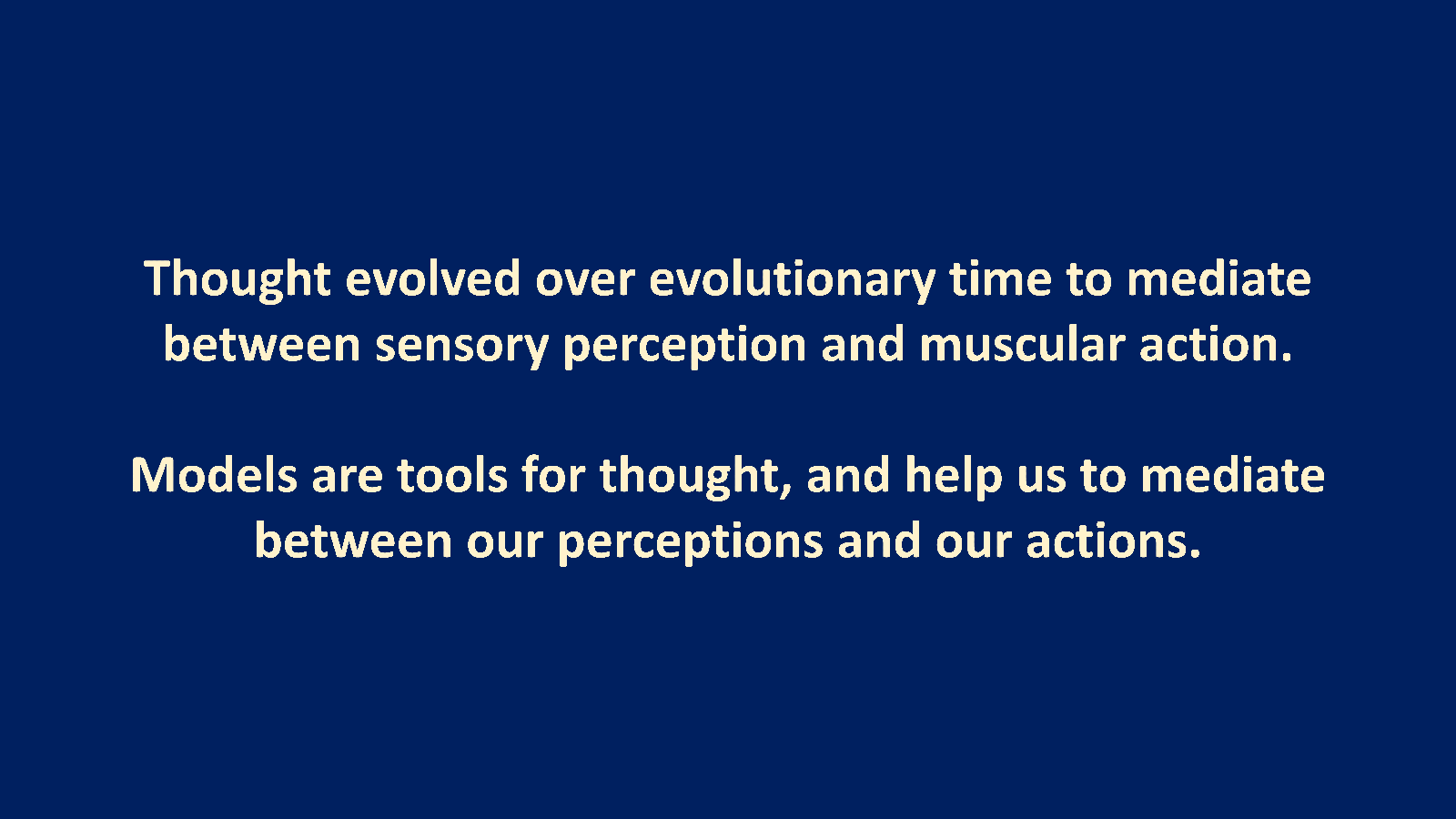
Thought evolved over evolutionary time to mediate between sensory perception and muscular action. Models are tools for thought, and help us to mediate between our perceptions and our actions.
Models are like crutches that allow our thinking to advance where it might otherwise be hobbled.
It would seem that recommendations of what sorts of modeling should be done should start with a discussion of what actions we are considering and what tools might be most helpful for informing decisions related to those actions, and then proceed to a discussion of the feasibility and resources needed to construct a model that could usefully inform decisions.
This question is particularly problematic when it comes to models involving social systems.
Clearly, there is some predictability to social systems: We can reliably predict that if political leaders engage in racially or religiously discriminatory speech that there will be an uptick in racial or religious violence within the society.
On the other hand, our primary goal is to inform decisions, not predict those decisions. We do not necessarily want to predict whether political leaders will engage in racially or religiously discriminatory speech, but rather inform the political leaders of the likely outcomes of their actions.
Further, while there is some predictive skill in predicting that increased prices will have a negative influence on demand, for example, the evidence of predictive skill for what we might call “future history” is limited at best.
There remains a major challenge in thinking through what sorts of models of social systems at global scale can usefully improve understanding and decision making at a cost that is commensurate with the value of generated information.
https://royalsocietypublishing.org/doi/10.1098/rstb.1986.0056
]]>Ken CaldeiraConsumption value and asset value2021-11-18T08:48:10+00:002021-11-18T08:48:10+00:00https://kencaldeira.com/2021/11/consumption-value-and-asset-valueMuch of my work gets done by way of “productive procrastination”, that is, working on things other than what I “should” be working on. This in an example.
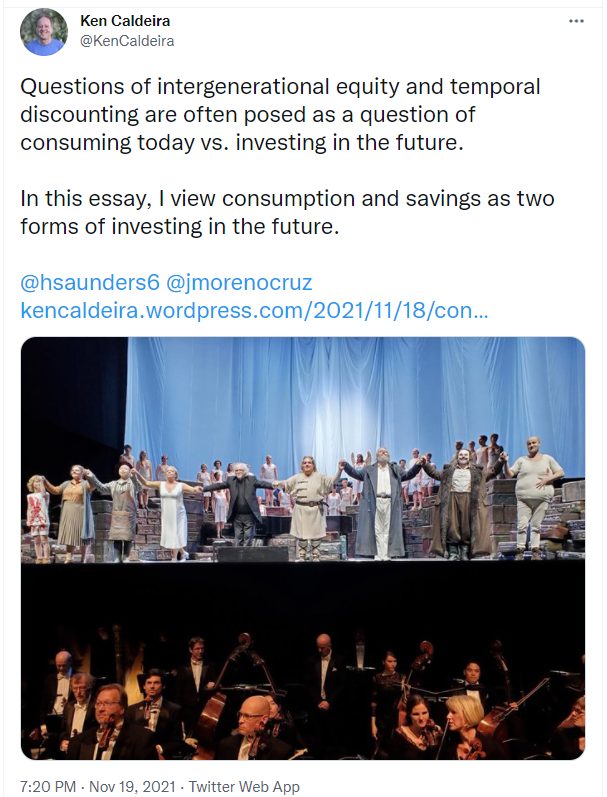
There have been differences of opinion about how best to address the question of temporal discounting, especially with respect to intergenerational equity and the climate problem. In its simplest form, this question is often framed:
How should we be valuing the future?
Lately, I have been taking a different tack on addressing this question, asking :
Why do we value the future as much as we do, and not more and not less?
One way of thinking about the discounting question is to ask: What is the relative value of consuming a thing versus owning a thing? How do we compare the consumption value of a thing versus asset value of a thing?
I have been working on a simple mathematical model to explore these issues, as a kind of “fiction science” – a make-believe world that I hope shares properties with the real world, to function as a mathematical metaphor.
From working with this model, I have convinced myself that we value the future as we do because organisms that valued the future (or at least, valued having an asset more than they valued consuming it) increased their evolutionary fitness.
The squirrel that buried the acorn was more likely to survive and successfully reproduce than the squirrel that didn’t bury the acorn.
The psychology of valuing the future is a product of an evolutionary process that tends to increase reproductive success and evolutionary fitness.
Paul Cezanne, Bridge across the Marne at Creteil, 1894
In an earlier version of my model, the agents hoarded assets until they had sufficient assets to achieve reproductive success. This led me to ask a question that I had never thought of before:
Why do we value current consumption as much as we do, and not more and not less?
If we are comparing consumption value versus asset value of a thing, we need to ask not only why we value the asset as much as we do, but also why we value consumption as much as we do.
And I think the understanding of consumption value largely parallels the understanding of asset value. We value consumption because consumption increases our evolutionary fitness.
If that squirrel did not eat acorns today, the squirrel will die and fail to reproduce. Note that the squirrel doesn’t die right now if it does not eat the acorn right now. Eating the acorn right now is another form of investing in the future.
Camille Pissarro, Autumn morning at Eragny, 1897
Consumption value and asset value are two forms of investing in the future, and the balance between consumption value and asset value is the balance that tends to increase reproductive success and evolutionary fitness.
Humans are not squirrels. I doubt squirrels explicitly think very far into the future.
Evolution gives us psychological properties that manifest in unpredictable ways. Evolution, for example, did not select for the ability to play chess, but the ability to play chess is nevertheless a product of our evolutionary past.
One of the properties of human psychology is, when given the opportunity, we tend to consume far in excess of what might be thought to be optimal for maximizing fitness.
Diseases related to obesity and over-eating are rampant in wealthy societies.
Further, people who have enough money, often consume expensive clothing, automobiles, live in large and expensive homes, and so on. They display their consumptive behavior.
What is the explanation for the human tendency to want to consume far in excess of what might be thought sufficient to maximize fitness?
One possible contributing factor is that humans evolved in a resource limited environment, so that we evolved to consume as much as we possibly could, because in most of our evolutionary history, consuming as much as you possibly could directly maximized fitness.
However, one might also imagine that earlier in our past, consuming beyond what was needed to sustain life signaled to potential mates that a potential partner would have the resources to feed and care for offspring – and thus increase reproductive success.
Our drive to consume beyond what is needed to sustain our lives may be in part a consequence of a psychology that improved our evolutionary fitness by signaling our desirability as mates.
Observations indicate that financially successful people tend to be more sought after as mates than people who are living at a subsistence level.
The potential mate that is able to give valuable gifts is likely to be the potential mate that can provide for offspring, increasing reproductive success and evolutionary fitness.
People’s happiness tends to be associated with their amount of consumption relative to their peers, and less so to absolute levels of consumption. This is consistent with the drive to consume being closely tied to social signaling functions that increase evolutionary fitness.
Our drive to excessive consumption might be a bit like the peacock’s tail – something that, absent the signaling value, would decrease our evolutionary fitness; something that is maintained through sexual selection.
One might imagine that, in evolutionary equilibrium in a simple system with perfect information, the marginal benefit to fitness from consumption would equal the marginal benefit to fitness from savings. This, I think, is the conceptual underpinning of determination of the optimal savings rate from the perspective of evolutionary fitness.
Paul Baum, Willows on the brook, 1900
Of course, we are not slaves to evolution.
We have a neo-cortex that not only allows us to play chess, but also allows us to be thoughtful about how we might increase our evolutionary fitness.
If our drive to excessive consumption is damaging the planet, we can use reason to develop ways to meet our psychological needs while lessening this damage. (An alternative is to deny our psychological desires, but this seems to be a much more difficult path both psychologically and politically.)
Paul Signac, The port at sunset (opus 236, Saint Tropez)
The increase in value from the service sector relative to the manufacturing sector (for example, the value we get from books, movies, music, and so on) points to ways that we can satisfy desires to consume with relatively little impact in the material world.
Rather than asking people to consume less, we can work on dematerialization of value generation. This can be done by expanding the service sector, for example by increasing the value of information and social relationships.
The internet is be a major step forward in human history. We are interacting with each other, often in real time, without the need for transportation. We are consuming music and videos and video games that can be replicated at very low marginal cost.
We may be entering a new era of increasingly dematerialized consumption may allow us to reconcile our evolutionary past with a future that places fewer material demands on our environment.
I thank Harry Saunders and Juan Moreno Cruz for contributing to some of the ideas expressed here.
https://twitter.com/KenCaldeira/status/1461761277097918472
https://twitter.com/KenCaldeira/status/1461769622634602504
]]>Ken CaldeiraAphorisms and over-simplifications2021-10-30T00:59:45+00:002021-10-30T00:59:45+00:00https://kencaldeira.com/2021/10/aphorisms-and-over-simplificationsA CURATED TWITTER FEED
Twitter is interesting because if forces you to try to say things in 280 characters. This tends to lead one to speak in Yoda-like aphorisms or make gross over-simplifications. (And on Twitter, there is no shortage of people to remind you of the myriad ways in which you are over simplifying.)
Also, for those insufficiently disciplined to compose offline and tweet only carefully edited tweets, Twitter is all about rough first drafts, preserved forever, warts and all.
Twitter is odd because it is both ephemeral and eternal — ephemeral in the sense that thoughtful tweets tend to get lost in the sands of time; eternal in the sense that some thoughtless boneheaded comment is there to pursue you for the rest of your life.
That all said, this blog post, which I expect to evolve over time, will be my place to dust the sand off of some old tweets so that they might live on a bit longer.
By the way, my “not-so-professional” Twitter account is @KenCaldeira.
A postdoc asked a question about being prescriptive and/or normative in academic papers, noting that some of the people with the most successful scientific careers were scientist/activists who did not shy away from saying in their technical work what we should do or what is good and what is bad.
My response:
It is fine to say “I think we should do XYZ” or “XYZ is good [or bad]” in an opinion piece in academic or informal settings.
But is it OK to make those kinds of statements in regular academic research papers?
A starting point is that there are multiple paths and strategies to success and you have to do something that fits your personal style and also takes account the reality of the job market.
My feeling has always been that we as scientists are trained to generate and disseminate information and our opining on public issues was just our hobby, not our profession.
That said, I am not above language of the sort: “Policy makers should consider doing XYZ” rather than coming right out and saying “Do XYZ”.
This may seem rhetorical artifice, but there is implicit acknowledgement in that construct that I may be wrong in my recommendation when a broader range of facts is considered.
I am probably near one end of the spectrum of wanting to keep recommendations to a minimum in academic papers (research suggestions, factors for policy consideration).
Others say that the distinction between opinion/informal pieces and scientific/technical reports is artificial and all that is required is transparency.
What should we do? Good or bad?
When something is written in an academic paper, it should be true and you should stand behind it for all time.
Usually the errors are not in what you did, but errors in interpreting the implications of what you did. Often the error is believing your result applies more generally than it does.
When I look back since graduate school, my policy prescriptions have evolved, but I stand by all of the basic findings I have published over the years.
]]>Ken CaldeiraEnough responsibility to go around2021-09-13T08:49:14+00:002021-09-13T08:49:14+00:00https://kencaldeira.com/2021/09/enough-responsibility-to-go-aroundON ATTRIBUTING DAMAGE TO CLIMATE CHANGE
To attribute damage to climate change, in principle we would like to fully understand the state of the system with climate change and then subtract out a counterfactual without climate change.
If we wanted to estimate the impact of current climate change on flood damage we could seek to understand current flood damage and then subtract off our best estimate of what would have happened in the absence of climate change.
Obviously, the stochastic nature of weather makes attribution challenging, but here I am after another conceptual issue.
We could have said, “The flood damage would not have been so bad had we not built valuable infrastructure in harm’s way.”
How could we attribute damage to building in harm’s way?
We could adopt a procedure that is similar to climate attribution: We could ascertain the observed damage under current conditions and subtract off what the damages would have been had we not built in harm’s way.
If we assume that damage would occur if and only if there were both climate change and a history of building in harm’s way, then this procedure would attribute the full cost of the damage to each of climate change and building in harm’s way.
The damage would not have occurred had we not changed climate and the damage would not have occurred had we not built in harm’s way.
Is there a truth to the matter in this case what fraction of the flood damage should be attributed to climate change and what fraction to building in harm’s way?
“Responsibility” is a social construct. Bad outcomes are often the consequence of a confluence of a series of unfortunate events, and there is no unique way of partitioning responsibility across the range of events that are jointly sufficient to produce the bad outcome.
We can agree on the empirical facts but disagree on how much responsibility for damage should (or should not) be attributed to climate change.
ADDENDUM
As a practical matter, as a climate modeler, if I wanted to estimate climate damage I would subtract results from a simulation without climate change from results of a simulation with climate damage, and I would attribute that full difference to climate change.
Also as a practical matter, if I were a coastal hazards investigator and I wanted to estimate the damage caused by inappropriate coastal development, I might compare cases with the same weather but with and without coastal development, and attribute the full difference to coastal development.
If a large number of studies examined damage with and without various factors (e.g., damage from failure to build adequate flood control systems), the sum of all of the attributed amounts could greatly exceed total damage.
There is value in these “all other things equal” studies, but in the real world other things are seldom equal.
]]>Ken CaldeiraIncome inequality and climate damage: Relative impact on utility2021-08-05T10:33:42+00:002021-08-05T10:33:42+00:00https://kencaldeira.com/2021/08/income-inequality-and-climate-damage-relative-impact-on-utilityWHAT WOULD THE DICE MODEL DAMAGE AND UTILITITY FUNCTIONS SAY ABOUT RELATIVE VALUE IN ADDRESSING INCOME INEQUALITY VS. CLIMATE CHALLENGES?
Dog deriving utility by watching a dog on television.
Nordhaus’s DICE model represents utility as population times per capita utility, and it represents per capita utility as increasing with per-capita consumption to the 0.45 power.
A lot of attention has been paid to the issue of temporal discounting in quantifying current value of future costs and benefits. That is, a lot of attention has been paid to assessing how we should value future generations relative to our own, but relatively less attention has been paid to addressing how we should value others living today relative to ourselves.
To address this issue, I thought I would look at the increase in total utility that would be predicted by the DICE utility functions under an assumption of income equality and compare that with the change in utility expected to come from addressing the climate change problem.
That is, what would the predicted change in utility be if everyone were brought to the mean income. (Before people start complaining, I too have read Kahneman and Ariely and understand that real utility is far more complicated than represented in the DICE model.)
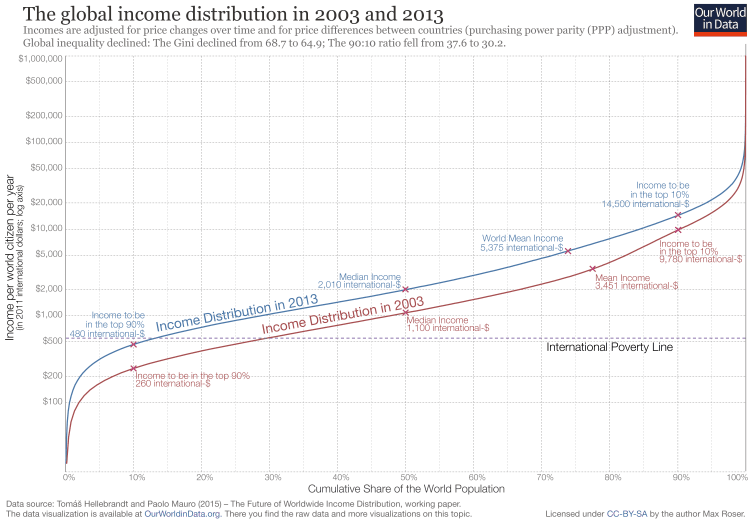
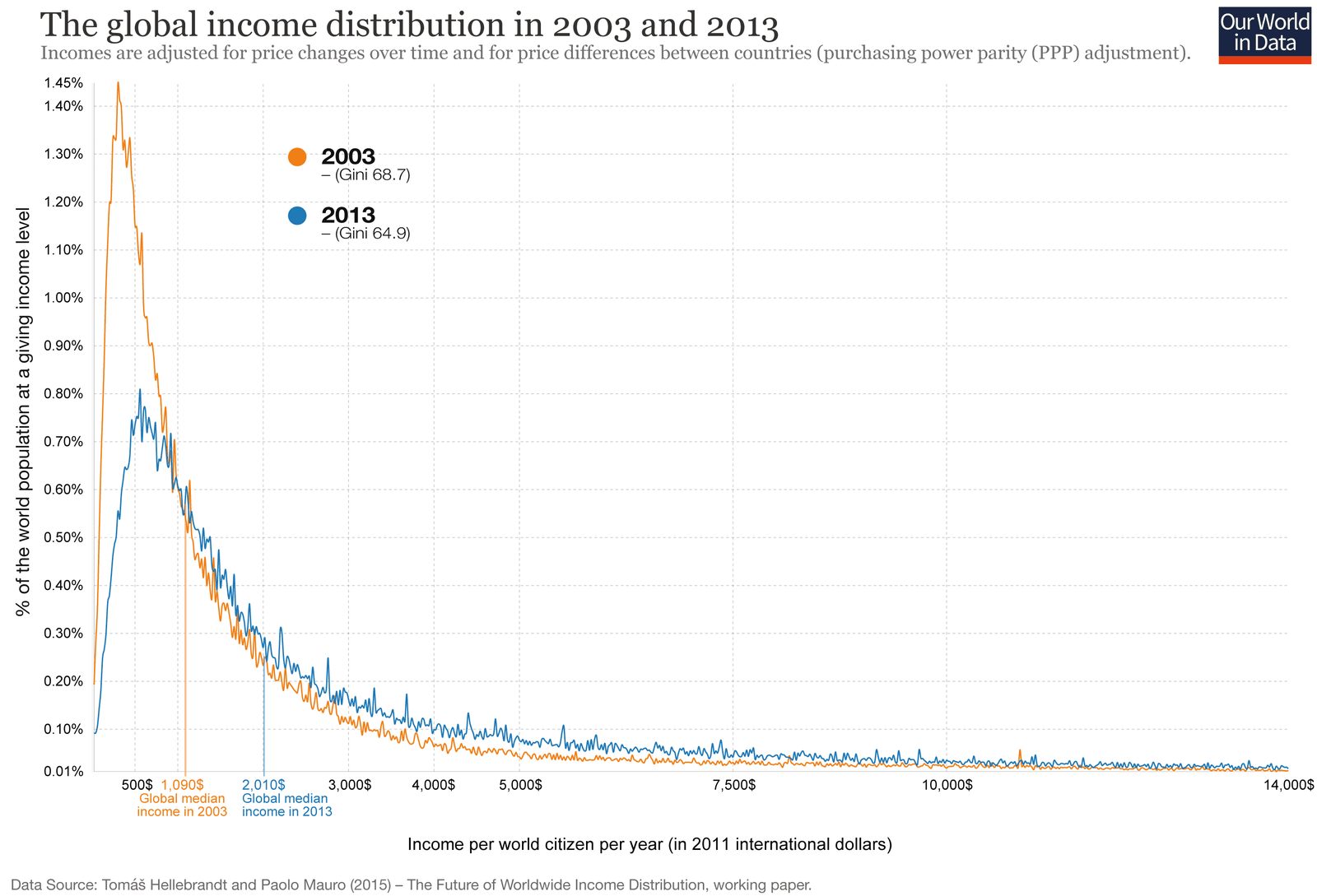
Unfortunately, I did not find a location to download this data easily. (I’ll fix up this blog post when I find it.) Therefore, I will just do a very rough-and ready analysis. Since they give us the median and the mean, let’s just assume this is a log-normal distribution with that median and mean.
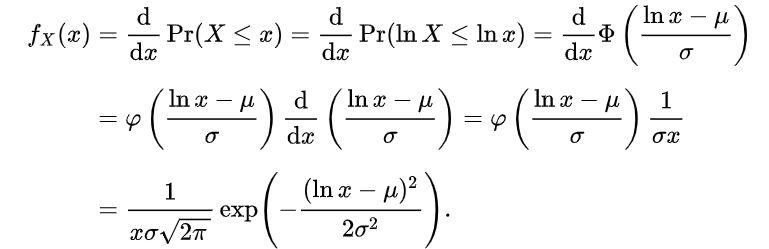
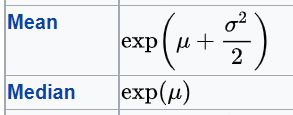
Luckily, trusty Wikipedia gives us the appropriate formulas for the median and mean of a lognormal distribution:
For a mean income of $5375/year and a median income of $2010/year, this yields mu = 7.6 and sigma = 1.4. (We will forgo pretense to greater accuracy.) Density of people making X $/yr can be estimated by plugging in these numbers into the lognormal function above.
If we now assume that utility goes with income to the 0.45 power, we can calculate that global utility is 78% of what it would be were income distributed evenly. That is, this analysis suggests we are taking a 22% hit on global utility due to income inequality.
This 22% reduction in global utility is of the same order of magnitude as some of the more high-end climate damage estimates and an order of magnitude larger than many climate damage estimates.
This suggests that if we are interested in human welfare, addressing income inequality may be as important as addressing climate challenges.
I know this is just a back-of-envelope calculation and human psychology is a lot more complicated than income raised to the 0.45 power and climate damage is a lot more complicated than temperature squared. No doubt there are complicated relationships between income distributions, capital accumulation, and economic growth. Nevertheless, this analysis suggests that income inequality may be regarded as a challenge to human welfare that is on a scale comparable to that of the climate problem.
Lastly, I would just like to point out that there are two ways of decreasing income inequality: increasing incomes at the lower end of the spectrum and decreasing incomes at the upper end of the spectrum. While some of both strategies may prove useful, it is only by increasing incomes at the lower end of the spectrum that we can increase aggregate utility without decreasing anyone’s individual utility. Thus, while income redistribution may have important roles to play, this suggests that economic development will be the leading player in increasing global aggregate utility.
]]>Ken CaldeiraAddressing market failures in energy technology deployment and discovery2021-07-19T20:54:01+00:002021-07-19T20:54:01+00:00https://kencaldeira.com/2021/07/addressing-market-failures-in-climate-technology-deployment-and-discoveryWE ARE LIVING IN AN “AND/AND WORLD”
I am a geoscientist who thinks about energy systems and climate policy, and while I have some general knowledge of energy systems, I do not claim any policy expertise, so this is just me thinking out loud and in public …
WARNING: This blog post is more prescriptive than most things I write.
Goldfinch
There are many people who put a lot of faith in the operation of markets who like to see governments do as little as possible.
Often, these people are OK with government action if someone can demonstrate that there is a market failure that government can address.
For the climate challenge, the most well-known market failure is the failure of markets to reflect future costs of climate damage in current prices. Where there is no price signal from future climate damage, markets continue to operate as if the operation of markets will not cause any climate damage — and this is driving us to dangerous climate change.
Economists often conclude that the most efficient way to represent this “unpriced externality” — an external cost that is not represented in market prices — is to have a carbon tax (or fee, if you prefer). A problem with this approach is that taxes are politically unpopular. A basket of policy approaches have been tried instead: carbon-trading markets, subsidies, regulations, etc.
These policies that drive technology deployment are addressing the “cost pricing failure” — the failure to represent costs of future climate damage.
“Unpriced future climate damage” is a market failure that is impeding deployment of clean energy technologies, but there is another market failure that is impeding development and improvement of energy technologies.
Horseshoe crab
Think of all the benefits of technology that we have today. Right now, you are using a computer and staring at a monitor screen. You have a cell phone. You’ve ridden in cars and flown in airplanes.
When these technologies were developed, some proprietary knowledge was generated and patented and this is a mechanism by which investors got rewarded for investing in innovation.
However, such innovative efforts also produced a lot of knowledge of a sort that is not patentable and where the benefits were not privatizable.
People watch each other.
When people see someone try to do something and fail, that gives people ideas on what they could do differently to succeed.
When people see someone try to do something and succeed, that gives people ideas on what they could do even better to out-compete them in the market.
Look around yourself right now: Can you find a single product in your field of view that was not informed by non-privatizable knowledge generated by private investment?
One of the things in my field of view is my DSLR camera.
This is a Canon camera, but the camera looks very similar to a Nikon or a number of other brands. Camera makers have converged on similar designs because there is non-privatizable knowledge about what works, what can be manufactured cost effectively and what can be sold into a market at what price.
Billboard in Wyoming, 2010
Economies and societies benefit from the non-privatizable benefits of private investment.
In most areas, we just accept that investment will be motivated only by privatizable benefits of an investment, and the entirety of non-privatizable benefits will go to other individuals or society-at-large. But the urgency and scale of the climate challenges warrant addressing this market failure specifically in climate tech innovation.
We can accelerate development and deployment of energy technologies that can help us attain net-zero emissions as soon as is practicable.
It is of course important to publicly fund the basic research that is the seed corn for long-term economic growth. But it takes risk-accepting investors to provide resources to develop the best ideas of scientists and engineers to the point where there is a product that can compete in the marketplace.
If the main reason we want private investors to invest in clean energy technologies is to benefit society, wouldn’t it make sense for society to provide incentives to generate that societal benefit?
The failure to adequately incentivize people to rapidly generate shared knowledge about better energy systems is a “benefit pricing failure” — a failure to provide a price signal to investors that reflects non-privatizable benefits of energy innovation.
Nearly everyone will benefit from cheaper clean energy technologies, especially-when those technologies can be nearly as cheap or cheaper than their CO2-emitting alternatives .
Ochopee, FL
In addressing climate challenges, one important market failure is the failure of markets to price social costs of future climate damage. Another important market failure is the failure of markets to price the social benefits of future cheaper clean energy technologies.
Policies that address the failure to price widely-shared benefits of energy innovation can be complement policies that address the failure to price widely-shared costs of climate damage. These policies address different market failures but are aimed at achieving the same goal.
And these two sorts of policies are complementary. Whatever the policy is that is aimed at driving deployment, having cheaper technologies will make that deployment-driving policy even more effective. With cheaper technologies, more clean energy technologies can get deployed faster and at lower cost — enabling earlier and deeper reductions in emissions.
We are not in an “either/or world”. The climate challenge is daunting enough that we need to live in an “and/and world”. We need policy drivers that promote deployment of clean energy technologies and we need policy drivers that promote development of better and cheaper technologies that are ready to be deployed.
Sunset
We do not have to choose between policies that drive deployment of existing technologies and policies that drive development of better technologies.
We can do both and we should do both.
]]>Ken CaldeiraHydrogen production from curtailed generation2021-07-07T19:18:52+00:002021-07-07T19:18:52+00:00https://kencaldeira.com/2021/07/how-much-hydrogen-could-we-produce-without-adding-additional-generation-capacityHOW MUCH HYDROGEN COULD WE PRODUCE WITHOUT ADDING ADDITIONAL GENERATION CAPACITY?
There has been a lot of talk about making electrolytic “Green Hydrogen” using electricity from wind and solar power that would otherwise be curtailed. Less climatically helpful, there is also potential to use electricity from natural gas generators that would otherwise be idled.
Tyler H. Ruggles, Jacqueline A. Dowling, Nathan S. Lewis, Ken Caldeira, Opportunities for flexible electricity loads such as hydrogen productionfrom curtailed generation,Advances in Applied Energy 3, 100051, 2021.
https://doi.org/10.1016/j.adapen.2021.100051
The system considered by Tyler is represented by the following figure:
The system considers several generators, a fixed (i.e. specified and unchangeable) electricity load, and a flexible electricity load, here represented as electrolytic production of hydrogen gas. The dispatchable generator can be thought of as something akin to natural gas, but is left unspecified.
The basic results are summarized in this figure:
The last column (Renew+Storage) is perhaps the most relevant to ongoing discussions of “Green Hydrogen”. In this case, all electricity is produced with wind and solar power. Because of the high cost of storage, with low amounts of flexible load, it is economically efficient to build extra wind and solar generation and then discard some of this potential generation much of the time (curtailment).
However, if we have a lot of excess wind and solar capacity, that means there should be times when there is some excess generation capacity that is going unused. Tyler showed that, with a system sized to meet peak demands, there is some underutilized capacity nearly all the time. Because this underutilized wind and solar capacity has effectively zero variable cost, this excess electricity generation can be offered for free.
Because systems are sized to meet peak demand and there is almost always some underutilized generating capacity, a small amount of flexible load can be added to the system at effectively zero electricity cost and operate at high capacity factors.
The problem is, as additional flexible load is added, there is less and less unclaimed free electricity to go around, and so additional flexible loads need to operate at lower capacity factor, or additional generating capacity would need to be added to the system.
Both of these things cost money.
As can be seen from the above figure, flexible loads can be added to the system with effectively zero additional generating capacity to the point where the flexible load is about 20% of total load.
In other words, if a system is built to satisfy firm loads, it is likely that an additional 25% of that fixed load can be used to satisfy flexible loads with out any additional capacity expansion.
Between about 0.2 and 0.8 (20% and 80% of total load) in the above figures, there is a transition zone, where adding more flexible load would motivate building additional generating capacity, and so the flexible load would need to contribute to this capacity expansion.
When the flexible load is already representing over 80% of the total load, additional flexible load basically requires 1-for-1 expansion of generating capacity and so the flexible load bears the full cost of capacity expansion.
The figure above illustrates this transition. Below a flexible fraction of total load equal to 0.30 in this example, the flexible load draws primarily on capacity that was built to help meet peak electricity demands. Thus the flexible load can largely be a free rider.
But at a flexible fraction of total load equal to 0.40, additional capacity must be added to meet this flexible load. In this case, the flexible load would need to pay for that capacity expansion.
Tyler created this graphical abstract in an attempt to summarize the findings of this study.
My experience is that the most valuable qualities in a scientist include things like creativity, intelligence, work ethic, ability to complete projects, ability to work well with others, writing skills, math skills, etc. These are qualities that Tyler has in abundance.
Our goal is to do simple analyses to highlight fundamental principles. Smart people can learn domain knowledge quickly. This is the kind of analysis for which physicists are well suited.
This study has come to conclusions that are likely to stand the test of time:
In systems designed to meet variable fixed loads, there is almost always some excess generating capacity and so almost always some electricity available to power flexible loads at the variable cost of the generator.
As this excess capacity is increasing utilized, typically when flexible loads exceed 20% of total demand, additional flexible loads will require some additional generating capacity, and in an economically efficient system this cost will be shared between fixed and flexible loads.
When flexible loads exceed about 80% of total demand, nearly every increase in flexible load requires a corresponding increase in generating capacity and so the flexible load would bear the full cost of this capacity expansion.
]]>Ken CaldeiraReplenishing the wind2021-06-29T19:43:36+00:002021-06-29T19:43:36+00:00https://kencaldeira.com/2021/06/replenishing-the-wind
People sometimes presume that when scientists set out to test a hypothesis, they are engaged in motivated reasoning and want to show that the hypothesis is correct.
While there might be some merit in that presumption, it is also the case that there are few things more pleasurable to the working scientist than being presented with evidence that your beliefs are false.
Working with Enrico Antonini, I recently had just such a pleasurable experience.
Like many other energy system researchers, I thought kinetic energy removed by wind turbines in large wind farms was replenished primarily by downward transport of kinetic energy from the overlying free troposphere.
For the first row of wind turbines, most of the kinetic energy transport is horizontal with the winds. However, each wind turbine can remove more than half the kinetic energy that passes through the disk swept by its rotors. The wind does not have to pass through many wind turbines before horizontal transport of kinetic energy is largely depleted. A source of kinetic energy is therefore needed to explain why wind turbines can still generate energy even when they are not in the first several rows of wind turbines.
Many energy researchers, including me, thought the wind energy was maintained by downward transport of kinetic energy from the overlying free troposphere. For example, in a 2017 paper published in PNAS, with Anna Possner as lead author, we wrote:
“However, it remains unclear whether these open ocean wind speeds are higher because of lack of surface drag or whether a greater downward transport of kinetic energy may be sustained in open ocean environments.”
In these papers, Enrico provides compelling evidence that the kinetic energy removed by wind turbines is replenished primarily by acceleration of air masses within the boundary layer by large-scale pressure forces (which are no longer balanced by apparent Coriolis forces due to the slowing of winds caused by the wind turbines).
Below is a schematic diagram of how things seem to work. Normally, large-scale pressure forces are balanced by apparent Coriolis forces resulting in what is known as “geostrophic flow”. However, as wind turbines remove kinetic energy from the winds, the apparent Coriolis forces weaken, and the unbalanced pressure gradient forces accelerate the air within the boundary layer.
Very little of the replenishment of wind energy is associated with downward transport of kinetic energy from the overlying free troposphere. The dichotomy we presented in our 2017 paper was a false dichotomy. Open ocean wind speeds are higher, but not primarily because there is less drag and not because there is substantially more downward transport of kinetic energy. The explanation for higher wind speeds over the ocean has to do with higher horizontal pressure gradients.
In the supporting material to the 2017 paper, Anna and I showed how wind power potential was closely related to heat fluxes at the planetary surface (blue are ocean areas, green is land; top to bottom is northern latitudes, tropics, and southern latitudes).
We presented this result without firm theoretical foundation. But now it seems that wind speeds over the ocean are high largely because ocean heat fluxes are high, and they can produce large temperature gradients, and these large temperature gradients can produce large pressure gradients, and large pressure gradients can drive strong winds.
Additionally, the theoretical understanding that Enrico developed predicts a length scale for recovery of winds downstream from a regional-scale wind farm. This length scale is the product of a time scale related to the Coriolis parameter times the geostrophic wind speed. The theoretical prediction of a length scale of several tens of kilometers is nicely supported by a recent study of wind speeds near large wind farms in the North Sea that which found a similar length scale in detailed simulations.
It is a real pleasure to be able to work with nice, smart, and productive people like Enrico Antonini. It is a privilege to be able to hire a bright early-career scientist who can show me my beliefs were wrong. And it is really nice to be working in a community where there is no great stigma to being wrong, if you are willing to adjust your beliefs in the light of new evidence.
Very few postdocs develop a fundamental theoretical understanding that makes testable predictions and has real world implications for energy system transition. (Enrico’s understanding can help people make a quick estimate of how closely wind farms can be spaced without them interfering with each other too much.)
If your department is would benefit from hiring somebody who understands scale-transition issues related with wind power development, you need look no further than Enrico.
This is an edited transcript of an interview I did with Katie Auth and Rose Mituso for their High Energy Planet podcast. They were kind enough to allow me to reprint the transcript of our discussion here. Originally distributed on 7 June 2021.
I did some copy editing to improve infelicities of verbal expression, but tried not to change meaning. [Bracketed clauses were appended to two sentences a little too unqualified for my liking.] You can go to the _High Energy Planet podcast for a more literal transcript._
_I thank everyone at Energy for Growth Hub _who helped make this a productive and enjoyable experience.__
KATIE: Ken, welcome to High Energy Planet. It’s so wonderful to have you here.
KEN: Thanks for inviting me.
KATIE: So we’re just going to dive in with a pretty big question, which is a couple of years ago you tweeted, “Imagine it’s the year 2100 and the poorest parts of the world are prosperous and carbon-free. What had to be true to make that happen?” And I’m curious how you yourself would answer that question.
KEN: I’m not an energy-systems engineer, and so I’m a little reluctant to make very specific predictions about future trajectories of energy systems. But to my mind, while wind and solar and a lot of these other technologies have a lot of nice properties, they require a real transformation of how our whole electricity grid works. It’s much simpler to have centralized power generation and distributed consumption.
There are very few energy sources that can provide huge amounts of power in concentrated forms with proven technologies without emitting carbon dioxide into the atmosphere. Nuclear power is one of the very few technologies that could potentially meet those requirements. And so if you would ask me, like, what’s the most likely way we can have a prosperous future with low carbon emissions I would guess it’s going to depend a lot on nuclear power. That’s not to say over the course of the rest of the century a lot of other technologies could be invented and developed. So I’m not making a prediction. But if you’re asking for my sense of what’s the most likely path to be successful given what we know today I would guess a heavy reliance on nuclear power.
KATIE: Not an uncontroversial position to take at the moment.
KEN: One of the things – and this is actually in many different contexts – I’ve found that often it’s better to argue for good process than to argue for specific outcomes. And so I don’t pretend I know what’s going to be the best technology mix in 2100.
But I do know that if we prematurely push things off the table and don’t subject various technologies to a fairly objective analysis that we might end up building some things that aren’t so good and overlooking things that could be very helpful. My focus is on trying to get good process and open, transparent, inclusive processes with obviously democratic and local determination for people [i.e., respect national sovereignty].
ROSE: So Ken, continuing this theme of prosperity and climate and balancing those two things, you authored a paper last year that found that if poor countries waited to decarbonize until they reached about $10,000 per capita GDP, it would cause less than .3 degrees Celsius’ additional warming. And that suggests that we should just leave poor countries to develop and kind of take down the climate pressure on that side. But on the other hand you’ve also returned a paper finding that less-wealthy countries shouldn’t be allowed to get locked into long-term fossil-fuel infrastructure. So how do we reconcile those two things?
KEN: Well, first of all to push back a little bit on your language, I probably wouldn’t have said “shouldn’t be allowed,” because I don’t think it’s my responsibility to tell others what they can and can’t do. And so…
ROSE: Very fair point. [CROSSTALK] You pass the Energy for Growth Hub Climate Justice Test.
KEN: [LAUGHTER] And so, the question is: How can we help make it in everyone’s self-interest to behave in ways that are also good globally?
If you look historically, the amount of emissions that have come out of sub-Saharan Africa is climatically negligible. It’s a little odd for the West, who’ve developed based on fossil-fuel emissions, to say to other countries, “Well, you can’t develop the same way we did.”
If you’re developing on a fossil-fueled economy what could we do to make it an easier transition off of that? And this is, again, coming back to this nuclear issue.
Let’s say you build a natural gas plant and it’s centralized. Maybe later you’ll replace that with a nuclear power plant and you still have a hub and spoke kind of electricity system. But if you think the future’s going to be wind and solar then you might want to build a different kind of electricity grid now even if it’s fossil fuel, in anticipation of this distributed system later.
ROSE: I think then this for me naturally leads to this question of, well, the people who are actually locked in are the rich people. How do we square that circle? You know, you’ve advocated for hard zero-emissions targets and you’ve likened this kind of hilariously to we need to seek to fully eliminate muggings of older ladies, rather than setting a rate for muggings that we can live with, you know? So basically we can’t live with old ladies being mugged, and we shouldn’t live with old ladies being mugged, and we shouldn’t live with more carbon in the air. But then you’ve also expressed a lot of skepticism about the viability of (coupled removal) at scale, which is central to many of our climate models and to this world that we live in that is fossil-based now and into the foreseeable future. So how do you reconcile these two positions if, okay, putting poor countries to one side you have some breathing room? What do we say to the rest of the world?
KEN: I’ve been a climate scientist, biogeochemist and climate physicist and so on, for my whole career. And then over the last years – more recently switched to trying to focus more on energy systems and solutions. With that was the recognition that most people most of the time operate in what they perceive to be their self-interest, and that you’re going to solve this problem when you align people’s self-interest with a more global interest. One of the ways you do that is by making the better energy sources even better and cheaper so that it’s the least cost approach.
In the same way that there is a portfolio of energy technologies that will be used, there’s a portfolio of political strategies. I find this somewhat disturbing, that… Some people should be working to pass legislation through Congress. And that means you need to – for the way the Senate is now that you need to get Republican votes. And so you have to be very careful. And there’s other people who should be saying, “oh, we need zero emissions today, and we should be sending boatloads of money to poor countries to pay their cost differential.” I see these different political strategies as supporting each other.
I wish that people could appreciate that there’s value in political disagreement.
ROSE: It’s an ecosystem.
KEN: Yeah, and that – and it really bothers me to go on Twitter and see people badmouthing each other who are working towards the same goal through different strategies. Because these strategies are complementary, if people would focus a little more on advancing their positive vision and a little less time expressing their negative energy about somebody else’s vision, we’d all be better off.
KATIE: So the political strategy of climate alarmism really didn’t work particularly well for about three decades. But now terms like “climate emergency” and “climate crisis” are part of policy lingua franca, and climate action is at the forefront of many policy agendas, at least rhetorically. So what do you think was the tipping point? And does using a framework of urgency change the way we think about or react to climate change?
KEN: One of the things that was important for changing the political landscape is the reduction in costs in wind and solar power, that in large part was brought about by Germany’s Energiewende program. The idea that it might actually be feasible to deploy some of this stuff, it might not cost that much, moved a lot of people to see the energy system transition as something that might be done realistically.
This shows the importance of cost, in that wind and solar got cheaper, making it feasible to deploy. This made people take energy system transition more seriously. That’s one component. A more thorough-going energy system transition will depend on making other technologies cheaper as well.
With regard to rhetoric, that’s a tougher question. The social dynamic encourages a ratcheting up of rhetoric, so that, okay, we have two degrees. Well, I’m going to say we should stabilize at 1.5 degrees. Well, I’m going to say 1.25. I’m going to – you know? You can always get some social credit by saying something slightly more extreme than what the mainstream view is now.
I used to say things like, “oh, we shouldn’t research adaptation because that will make people acknowledge that there’s going to be climate change, and that – just make it more likely, so we should just work on climate-change avoidance and not on adaptation.” And I used to be somebody who was taking the more extreme positions and saying negative things about people who are taking more compromising positions.
I don’t think any of my beliefs about, like, if I were the benevolent dictator of the world what would be the good thing to do is, have shifted. What has shifted is my sense of how change happens in the world.
Change happens by making more people see it in their self-interest.
ROSE: You sound like a man who’s briefed Congress, Ken [LAUGHTER]. You know, out of the lab and into Congress.
KEN: Well, one of the most depressing things for Congress was – this was on ocean acidification – I testified in a hearing for some legislation for money to fund research into ocean acidification. At the end of it, after the formal testimony was over, the staffer walked up to me and said, “Okay, so what part of ocean science’s budget shall we take this money from?”
ROSE: Oh no.
KEN: “Because of course we’re not going to expand funding for marine sciences.” And I felt, like, oh man, I did all this work just to shift…
ROSE: Oh Ken.
KEN: …(how) that marine science (inaudible) was.
ROSE: There’s some species of jellyfish or octopus or something that’s dead because of you [LAUGHTER], unstudied.
[MUSIC]
ROSE: Coming up, we ask Ken about his mixed feelings about geoengineering and his new approach to Twitter.
KATIE: And we play Rant or Rave to find out about his checkered past as a bassist and a pumper of crocodile stomachs.
[MUSIC]
KATIE: So Ken, you’ve been advising Bill Gates for about 15 years I think on climate change, arranging learning sessions for him with climate scientists and thinkers from around the world. I’m actually curious, how did you go about designing that curriculum when you’re dealing with one of the most complex and multidimensional issues on the planet? Where do you start?
KEN: What I really liked about these sessions is that I could get these world’s leading experts in whatever – hydrogen, cement, battery technologies, whatever – and I could be there asking the stupid questions and being the student. And being willing to expose my own ignorance all the time – I think me feeling comfortable with that also let me play this role well.
I figure if I have a question there’s probably other people in the room with the same question.
I used to feel like I knew what to do politically and that I also felt like I knew a lot of things. And as time has gone on I’ve become less sure I know the right things to do politically and more accepting of a diversity of political strategies.
My awareness of what I don’t know has grown faster than my knowledge.
This has put me in a good position to be in these kind of helpful and advisory roles. Because – and I also have a commitment to process – let’s have an open, inclusive, and fact-based process. And so all of these qualities put me in a good position to be in roles where I’m trying to help develop a good process, and bring in good information, and help facilitate others to make good decisions.
ROSE: That’s really great, Ken. I wonder how much this kind of softening of your posture has equipped you for Twitter fights. But that’s – we’ll discuss that later. Where, you know, it’s very absolutist now, like, where you have to know and speak with so much confidence.
KEN: I’ve actually changed my Twitter strategy substantially and with very positive outcomes.
Basically I’ve decided to try to not say anything negative on Twitter, and not to respond to negative comments to me, and try to be entirely positive on Twitter.
And I see this in my own family relations or spousal relations as well. Often we say negative things and it’s more about us releasing our negative emotions, and it’s not really about trying to effect positive change in the world.
It’s very rare that a negative statement produces a positive outcome.
I see this even with my postdocs and students, where if I’m not very careful, even if I’m trying to make a positive suggestion, people can hear that as a criticism of what they did wasn’t good enough.
People get hurt very easily. We’re just not aware of how much our negative statements hurt people.
Unless you’re really sure that a negative statement will produce a positive outcome, you shouldn’t do it. It’s more about yourself trying to get attention or releasing emotions, and not really about trying to help anybody. And so, yeah, I think just being a little thoughtful – am I helping somebody by doing this?
KATIE: So we wanted to talk a little bit about geoengineering. In the past you’ve called yourself a [quote] “reluctant advocate” of researching solar geoengineering. And as of 2014 you thought there was maybe something like a 20% chance that somebody would ultimately try it. And, you know, now we’re in 2021–would you bet on different odds today?
KEN: All the model simulations of solar geoengineering suggest that it would basically work to offset most climate change for most people, most of the time.
Now, it doesn’t save you the need to do an energy-system transition, because everybody acknowledges that if greenhouse gases continue to accumulate in the atmosphere and you continue engineering the planet to mask that, that eventually that’s going to lead to some pretty nasty outcomes.
On the other hand, if we get to mid-century or beyond and there’s massive crop failures throughout the tropics and widespread suffering, and richer countries aren’t really doing anything to alleviate that suffering, solar geoengineering is basically the only way known to cause the planet to cool within years to decades.
Basically if you zero out emissions the planet even continues to warm; it doesn’t start cooling for centuries. And I don’t know what the likelihood of some kind of crop failure throughout the tropics is. But, if that should happen…
Well, first of all I’d also like to say that I don’t think there’s any reason why anybody, even in that situation, anybody would need to go hungry in the world. Because there’s enough food produced, if you look at all the waste of food going on in the United States and Europe and so on. I think if there ever is geoengineering it’s going to be multiple failures. First of all, the failure of the social system to prevent the CO2 emissions. But, then the direct climate crisis. But then it’ll also need to be a social failure that the global community doesn’t mobilize to address issues. But, the global community hasn’t been very good at mobilizing to address important issues to date.
I don’t know what the likelihood that there’ll be something perceived as an acute climate crisis that needs to be dealt with right now. But if that’s felt the only – solar geoengineering is really the only thing that could cool the planet [within the politician’s political career]. And, if you were the leader of a country and people were starving to death, and you felt that you could save lives by solar geoengineering, you would be remiss not to give it serious consideration. And so I don’t know what the chances are of having widespread famines or something like that, but if that happens the possibility of solar geoengineering could be quite high.
KATIE: Do you worry that the prospect of geoengineering, kind of having this as a last-resort solution, kind of impedes action now?
KEN: I don’t think it really does. There are different metaphors, but I would look at solar geoengineering as like morphine for the cancer patient, in that it provides some symptomatic relief but it’s not addressing the root causes. If you have cancer, morphine can be extremely valuable. So symptomatic relief shouldn’t be scoffed at.
But I don’t think that the prospect of solar geoengineering is preventing action on climate change. There was some rhetoric in that direction maybe a decade or so ago. But I think now everyone understands that even if you’re doing solar geoengineering you still need to stop emitting CO2. It’s doesn’t work to do both at the same time.
KATIE: Yeah.
[MUSIC]
ROSE: Okay Ken, now it’s time to play Rant or Rave. So this is a quick-fire game where we say a word or a term and you go on a short – very short rant or rave about it. Are you ready?
KEN: Okay, I’ll give it a go [LAUGHTER].
ROSE: All right, rant or rave: hallucinogenic drugs?
KEN: I enjoyed them when I was in high school. I would be afraid to take them now.
KATIE: Rant or rave: pumping crocodile stomachs?
KEN: Not pleasant, a little bit similar to (inaudible), but a very interesting experience. Before I went to graduate school I was a software developer in the financial district in New York. And between software development projects I did other kinds of projects. And one of the things I did was go to Mexico and work as a field assistant to some herpetologists in the Mexican rainforest, the Selva Lacandona. And one of the things that they were doing was ecological study of the crocodiles there and looking at both their population and what they were eating. And so we were out there trying to catch crocodiles, and tag them, and pump their stomachs and see what they’re eating. And so a crocodile sits with its mouth open and basically waits for a fish or something to swim past it, and then it closes its mouth. And even a grownup crocodile will eat little bugs and little tiny fish. And they might just get, like, one fish a month. And that was actually the experience that made me go back to graduate school and get a PhD. Because I thought, oh, if I don’t get a PhD I’m always going to be somebody’s field assistant. If I want to lead expeditions I have to get a PhD. And it was a really fun and interesting thing, and really my motivation for going back to – to going to graduate school was to try to lead field expeditions in the rainforest, which I never did. But I did finally get to go to coral reefs so that’s pretty good.
ROSE: Climate purity tests?
KEN: I don’t like them so much.
KATIE: Okay, this is a throwback. Punk-funk and Fists of Facts.
KEN: I like playing bass guitar, and I still – I played last night, but just by myself. I went to Rutgers College in New Jersey and a bunch of my friends and I all moved into New York City when we graduated. And all my friends were artists and musicians in fairly reasonably-successful bands. And I went and did computer programming work on Wall Street, which was, like, the boring thing to do. But I still played music with my friends, and we had a band and we called it “Fist of Facts,” an idea – even then it was the idea that facts did have this political import. Even before graduate school I was still on that kind of thread [CROSSTALK]…
KATIE: Science fights back.
KEN: Yeah. So – and we played – we were basically fans of Fela Kuti and had our downtown New York version of Afrobeat I guess and reggae kind of stuff. So that was our [CROSSTALK].
ROSE: That’s awesome. [LAUGHTER]
KATIE: We have to look you up after this.
ROSE: Definitely on (Spotify).
KEN: [CROSSTALK] We’re not so good. But we’re on Spotify, so… [LAUGHTER]
ROSE: That is so great.
KATIE: All right, final one. Bets with Ted Nordaus?
KEN: Oh yeah. So we’ve had about whether…
ROSE: The (peaking) emissions.
KEN: …[CROSSTALK] have CO2 emissions already peaked? And I think I’m going to be winning a bet very soon.
ROSE: All right, good one.
KATIE: Unfortunately yeah.
KEN: And this was actually even symbolic on this bet, because we had to say what charity we wanted to give it to. And I said I want to give to the Doctors without Borders to say, look, it’s not all climate change.
ROSE: All right Ken, thanks so much for being with us on High Energy Planet. We’ve really enjoyed this discussion; it’s been a lot of fun.
KATIE: Thanks Ken.
KEN: Thank you.
https://www.energyforgrowth.org/projects/high-energy-planet/
https://www.energyforgrowth.org/
]]>Ken CaldeiraPodcasts aimed at professionals in other professions2021-03-14T12:02:22+00:002021-03-14T12:02:22+00:00https://kencaldeira.com/2021/03/podcasts-aimed-at-professionals-in-other-professions-2I have been enjoying podcasts made by and for professionals in other professions. Sometimes, but not always, these podcasts related to my hobbies.
It becomes apparent that many of the same qualities are characteristic of people who are successful in different domains. Further, the advice people give regarding how to be successful is largely the same, independent of the specific domain. These qualities include (in no particular order):
— Working hard
— Aiming to be helpful and valuable to others
— Learning your craft skills
— Working even when there is no prospect for immediate reward
— Surrounding yourself with excellent people
— Being creative, trying new things
— Being a lifelong learner
— Being ready to drop a suggestion if nobody else is interested
— Being pleasant to work with
— Focusing on the success of the group effort, rather than individual glory
And some of my favorite podcasts are:
Bold as Brass Podcast
Host Melissa Brown chats with trombonists, tuba players, trumpet players and so on. It is really great to listen to people who have chosen to follow their life passion talk about their work and lives. (Nobody becomes a brass player to become rich.) Every episode is excellent but a nice one to start with might be the Roger Argente episode.
Scriptnotes
These episodes contain both discussions about writing screenplays and about the screenwriting industry. For most people like me, the episodes that focus on craft are probably more interesting than the ones that focus on the industry. A good episode to start with might be the “Sexy Ghosts of Chula Vista“.
]]>Ken CaldeiraOcean acidification: A career journey from curiosity-driven science to a search for solutions2021-02-27T14:12:05+00:002021-02-27T14:12:05+00:00https://kencaldeira.com/2021/02/ocean-acidification-a-career-journey-from-curiosity-driven-science-to-a-search-for-solutionsI was asked by Stephen Macko to produce an abstract for a lecture for the University of Virginia this coming week, aimed at a general audience and centering on ocean acidification. The abstract went on a little long, so I thought I’d put a version of it here, with links. When I get a link to the Zoom, I’ll put it here. 3:30 PM ET on Thursday 4 March 2021.
Carbon dioxide is a greenhouse gas, but when it dissolves in seawater it becomes carbonic acid. In high enough concentrations, it can be corrosive to the shells and skeletons of some marine organisms. In lower concentrations, it can make it harder for many marine organisms to survive. This talk will discuss ocean acidification in the context of the arc of my career.
Title and abstract from my first paper (Caldeira, Nature, 1989). This two-page paper counted as my Master’s Thesis. I was told it was the shortest Master’s Thesis in NYU history.
A decade or so later, I was working on a project related to ocean carbon sequestration, and we were comparing the effects of atmospheric versus oceanic releases of carbon. We noticed that the changes in ocean chemistry inferred even for atmospheric releases were outside of the range of variability of ocean chemistry for most of geologic time. This observation led to a publication in Nature magazine, and activities helping to publicize the issue of ocean acidification, including congressional briefings and a major article in The New Yorker.
Coarse-resolution ocean modeling can yield only so much information, so I hired excellent postdocs with field experience and initiated a field program leading to the first experiments ever in which ocean carbonate chemistry was altered in situ in the absence of artificial confinement, and the biological response measured. Thesestudies were also published in Nature magazine.
There is only so much diagnosing a problem can do. At some point, you want to solve the problem. I believe a large part of the solution will involve building a better energy system. I have been extremely lucky in that I have been given the opportunity to be leading a group of researchers, and supporting Breakthrough Energy (and Bill Gates) in some of their information needs aimed towards building a better energy system, one that can meet human needs without large negative environmental impacts.
Schematic diagram illustrating some possible options for net-zero emission energy systems (Davis et al, Science, 2018)
And now my soapbox: We need diversity not only with respect to gender, race, socio-economic background, career-stage and so on, but also in terms of curiosity-driven vs. problem-driven science, long-term monitoring vs. hypothesis-driven science, mechanism-based vs. system-level understanding, and so on. A robust scientific enterprise is a diverse scientific enterprise.
]]>Ken CaldeiraWagner scores on YouTube2021-01-15T16:28:30+00:002021-01-15T16:28:30+00:00https://kencaldeira.com/2021/01/wagner-scores-on-youtubeI am trying to maintain links to some good Wagner recordings with scores on YouTube. If these links are broken, please let me know by email. This is not meant to be complete, so email me about another version only if it is better or nearly as good.
Humans are very good at solving problems that are very immediate and where the person who solves the problem benefits from that solution.
Unfortunately, climate change is a problem that manifests itself over decades and centuries, and the benefits accrue to basically everybody but the costs accrue to whomever is reducing the emissions.
Welcome to Straight Talk, a podcast about big ideas from some of the world’s foremost thinkers and doers.
I’m Hank Paulson, Chairman of the Paulson Institute.
He has made pioneering discoveries in areas such as ocean acidification and energy system modeling and is known to be an out of the box big picture science with diverse interests.
Ken, welcome to the podcast.
Hi, great to be here, Hank.
Ken, I’m really looking forward to our conversation today. I’ve talked with a lot of climate scientists but few of any or as good as you are in big picture thinking. You’re able to put it all together and break new ground in the questions you ask, the areas you study and the solutions you consider.
Valley Stream, New York (earth.google.com)
EARLY DAYS
But before going big, I’d like to go to near the beginning: How did you get interested in science and when did you first develop your strong interest in climate change?
I think my interest in science began when I was a kid, due to the Apollo space program.
I’m hoping that energy and responding to climate change might have some of the same effect of really revitalizing science and education in the United States. It was these kinds of governmental programs when I was a kid.
But then how did I get into climate science?
As an undergraduate, I learned computer programming, and [after graduation] was doing software development in Wall Street in the Financial District, basically looking at mergers and acquisitions for places like First Boston and so on.
I remember reading an article in the New York Times. Steve Schneider spoke at a Congressional testimony and also spoke at a [AAAS] meeting and talked about how we might be melting some of Antarctica.
And this kind of blew my mind – the idea that us little puny humans could influence something as big as the Antarctic ice sheet or global climate really surprised me.
And so I just started going back to graduate school in the evenings just for fun to learn about it. And I turned out to be their best student. They offered me a fellowship. I quit my job on Wall Street and the rest is history.
Wow, I tell you, as I have gotten to know over the course of my career, people that are best in class in their various professions, they all have one thing in common, intellectual curiosity. Intellectual curiosity.
And, it’s amazing, I remember Sputnik like it was yesterday. It was just that was huge, wasn’t it? And then Neil Armstrong landing on the moon, Alan Shepard, all that.
It was a fascinating, fascinating, time in our history.
One thing that separates me from most other climate scientists is having spent (I forget what it was) six or eight years working in the financial district in New York because you get a real sense about … . You understand discount rates and you understand competing opportunity costs for using resources in one way rather than another.
I feel that this time in the financial district in New York has informed a lot of my thinking and was very useful_._
Lower Manhattan (earth.google.com)
CLIMATE CHANGE
We’ll get to that in a bit because one of the things that’s impressed me about my conversations with you is you really work to understand the economics of all these uh solutions or potential solutions and so when we get to talking about open air carbon capture and some other things you’re focused on the economic realities and a matter of fact everything you’re doing is grounded in in practical realities how will this work what do we need to do so let’s start with the basic core question how big a challenge is climate change?
There’s two different ways to think about how big the climate change problem is.
One is “Well, what are the bad things or possibly even good things that could happen with climate change?”
But the other is the game theoretic challenge of how hard is it to solve this problem because of its logical structure.
If we look out centuries [and ask] “what are the consequences of continuing in our current modes of generating energy or converting energy for human uses?” [we’ll find] that we’re adding greenhouse gases to the atmosphere and eventually we’ll melt all the ice sheets and sea levels will go up 200 feet. We’ll be restoring ourselves to the kinds of climate that existed when the dinosaurs were around.
I’m not with Leibniz and thinking this is the best of all possible worlds, but there’s a lot of disruption that comes with this change.
Losing essentially every coastal city in the world is a cost that we don’t want to take on. There are also concerns about crops growing in tropical countries – how it’s already difficult to work outside in the sun in most of the tropics and if it gets hotter and there’s already heat stresses causing reductions in crop yields … . And so, there’s potential for large parts of the tropics to become unsuitable for growing crops and so the risks are very large.
Unfortunately, humans are very good at solving problems that are very immediate and where the person who solves the problem benefits from that solution.
Unfortunately, climate change is a problem that manifests itself over decades and centuries, and the benefits accrue to basically everybody but the costs accrue to whomever is reducing the emissions.
This logical structure, where the costs are borne by people today but the benefits are widely distributed and come mostly far in the future, that’s a really tough problem from a political and economic perspective to address.
We’ve been doing some simulations using integrated assessment models. For the next 60 or so years we’re going to want to invest more in emissions reduction than that emissions reduction will offset in damages.
We’re asking this generation to invest for future generations, and that’s a tough ask.
Yeah. I totally agree that we do best when the crisis is immediate right as opposed to long term, and we also do best when the crisis is national as opposed to global, and this is longer term and global.
But, I want to turn that around a bit, because most of the thinking and it is directed where it should be when we’re looking at the most adverse consequences which are long-term consequences, but there are also some immediate consequences.
Wall Street (earth.google.com)
NEAR-TERM CLIMATE CONSEQUENCES
Many people don’t understand that no matter what we do today, as a result of the carbon that’s already up there in the atmosphere, there are going to be some very real impacts of climate change some very real shocks in the next decades.
The question I have to you is: How should we look at those? And what surprises are out there that are possible in the next 10 20 30 years? And how should we think about resilience and adaptation preparing to deal with the shorter term shocks?
There’s evidence that global warming is causing storms to become more intense now. We’re also putting more and more infrastructure in harm’s way.
We can expect increased storminess increased flooding, increased heat waves leading to crop failures, and some deaths of vulnerable people.
But what we’re seeing in the next decades is going to be the tip of the iceberg.
Climate change is something that’s cumulative. Each emission basically adds another increment of warming.
If we stop emissions today the Earth doesn’t start cooling for the better part of a thousand years.
Even if we were to stop today, we don’t make things better we just prevent it getting worse.
And it’s extremely difficult to reduce emissions and so the likelihood is for emissions to go up, the amount of warming to go up, the amount of heat waves, floods, severe storms, and so on, going up.
I know that people focus on what’s coming in the next decades in an effort to try to motivate people to do something now but it’s really whatever comes in the next decades is like that’s just like the little tip of the iceberg and what’s really coming down the pike is really gigantic.
Yeah, I agree with you.
People have conflated two things: the “what’s coming in the next couple decades” and “what we need to do in terms of resilience and adaptation with the longer term issue in terms of mitigation”.
We don’t want to ignore what’s coming in terms of where we build and what we do because there are going to be some very real changes immediately and we need to prepare for those. But you’re totally right in terms of where the big risks are.
Most of the climate change that will happen in 10 years from now is already baked in. It’s really only one more decade’s warming.
If you’re trying to deal with the effects of climate change in 10 years it’s adaptation that’s going to reduce that risk.
We need to really get on the program of reducing emissions to prevent the much bigger changes down the road but [in] the near term it’s mostly about let’s build the right kind of infrastructure.
Absolutely. Let’s prepare. Let’s protect our economic security. Let’s adapt. Let’s build in resilience to deal with what’s going to come.
That’s a very, very, different problem from that of avoiding the very worst outcomes which are certain to come unless we act.
Natural gas plant near Gowanus canal, New York. (earth.google.com)
SEA-LEVEL RISE
I want to come back briefly to where you started because you read something about the Antarctic ice shelf melting and now a lot of respected scientists are saying that the process of irreversible melting is going on in Greenland and the Antarctic ice shelf. What does this mean in terms of sea rise and over what time period?
The central estimate for Antarctic melting is around an inch a year for the next 10,000 years or so. That’s more-or-less a foot a decade or more-or-less 10 feet each century, which is like a floor of a building.
And so what we’re doing over the next decades is really going to affect people living on this planet for many thousands of years.
Indian Point Nuclear Plan (earth.google.com)
ENERGY
Ken, now this is a part of the interview I’m really looking forward to.
What are the things we can do what are the things that science can develop that will let us avoid these or help us avoid some of these most adverse impacts? Talk about science, where science is now, where we need to get. What are the areas where we can have big breakthroughs that make a significant difference?
The main cause of global warming is carbon dioxide emissions from the burning of fossil fuels in our energy system, and that’s both fossil fuels to generate electricity to provide gasoline for cars and jet fuel for airplanes and heat to make steel and aluminum, and so on.
Most analysts now believe that the way to move forward on this is to electrify as much of the economy as possible.
We see this transition now with going from gasoline cars towards electric cars, but electrifying the economy doesn’t do anything if you’re using coal to make that electricity in coal plants emitting the CO2.
The next step is to (the jargon is) decarbonize the electricity system. And that means either basing it on inherently carbon-free technologies like solar power wind nuclear. Or another idea is to burn the fossil fuels and then capture the CO2 and throw that CO2 underground. Now that unfortunately is still expensive.
The cost of solar and wind have come down dramatically. The problem with solar and wind is that you often want electricity when the wind isn’t blowing and the sun isn’t shining and electricity storage is still very expensive.
Wind and solar can penetrate electricity systems a bit now but to really do the entire job with wind and solar we would need much better storage technologies than we have.
There’s a whole suite of different energy system innovations that people are thinking about. There’re other sources of emissions like cement and land use change, but those are less important than the energy system.
That’s a very good summary.
Always when I will talk with people that are looking for huge scientific breakthroughs, I always come back and say to them, “It’s cumulative. Every bit counts whether it’s behavior change whether it’s reducing emissions whether it’s moving to cleaner renewable sources of energy.”
Marsh at Charles Point, New York (earth.google.com)
BREAKTHROUGHS
But there also are some very big out of the box ideas that you’ve considered which is: “Is it irreversible the emissions we’ve put in the atmosphere?”
What about you’ve done work on open-air carbon capture talk a little bit about that in terms of what this is what the science is what the economics are how you think about it?
Let me talk about a few of these crazy out-of-the-box things which are fun and I enjoy, but before I do that let me just say, “I like thinking about the big breakthroughs and one of the crazy out of box things that could maybe come in the future … “
We need to realize that if you think about how much solar power got cheaper over the last decade or two, and a lot of that was really Germany putting subsidy on rooftop solar and so on, and the Chinese responding to that by building all of these solar photovoltaic factories, and they just step-by-step increased the efficiency and reduced cost through hundreds of tiny little improvements.
And so, in the case of solar, at least, we saw more-or-less what you’d have to call in aggregate “a breakthrough” that really was the accumulation of a lot of tiny little improvements of learning by doing and so on.
While I’m going to talk about some big breakthrough kind of things we need to remember that a lot of progress comes in a lot of little tiny steps.
Ken, I agree with you totally and I’m a big believer that if we put a price on carbon emissions that we will see incremental steps that will add up and make a big difference.
If we have the right incentives the right regulatory policies the right way to price emissions and pollution will make a huge difference over time. And we never want to take our eye off that ball. And I think behavior changes, but I do think it’s interesting to talk about some of the big ideas.
The danger of course is people will say well maybe we don’t have to do anything because at the end of the day there’s some huge idea that’s going to save us all.
Imagine if it was 1920 instead of 2020.
The things we have today would seem like magic.
Solar photovoltaics – nobody ever thought about that. There was no silicon chip in 1920.
Nuclear power would have been just a science fiction story.
The idea that wind power would come back, that aviation would be big, that we’d have cars all over the place, and …
We do ourselves a disservice by not using a lot of imagination when we think about the future. We just shouldn’t believe our imagination too much. But anyway… so to come up with some of the basic ideas ….
One basic idea is, “Well, if we’ve emitted all this carbon dioxide to the atmosphere, can we go and grab it out of the atmosphere and pull it back out?”
And we know this is possible because plants do it all the time. Plants take carbon dioxide out of the atmosphere powered by sunlight and convert it into carbohydrates with chemical energy.
One way you can pull CO2 out of the atmosphere is to grow plants and that’s the whole idea of biofuels and bioenergy and so on. Or you could also potentially bury that biomass. And people have even talked about taking hydrogen from other sources and upgrading that carbon to make aviation fuels based on biomass.
The simplest way to draw CO2 out of the atmosphere is grow plants, but the problem is that plants take a lot of area and are very inefficient. But they are self-assembling little robots, so that’s good.
Various groups, especially one in Switzerland and one based in North America, have developed chemical processing approaches to extract CO2 from the atmosphere. The problem is it’s expensive.
That said, there are some very difficult to decarbonize parts of the energy system. Let’s say you want to fly from New York City to Sydney in an airplane. There’s just no battery that’s light enough to ever power a jet plane like that and so dense hydrocarbon fuels are still the fuel of choice.
The idea is, “Well, maybe you could still use fossil fuels for that long-distance aviation but then have a plant somewhere pulling that CO2 out of the atmosphere.” My guess is it might get used for these kind of niche applications but it’s not going to be the main show.
It’s just too expensive in my judgment.
There’s also sort of crazy out of the box ideas for electricity generation and my favorite one (and this one’s crazy a bit) is …
We did a study looking at the power in the jet streams. These are the those powerful winds that are more-or-less up above where the jets fly.
On a good sunny day you might get one kilowatt of power per square meter [from sunlight] in the middle of a desert in the middle of the day. You can get 10 or 20 times that power in winds in the jet stream.
If we could ever get flying wind turbines in the jet streams there’s more than enough power there to power all of civilization and it’s pretty steady. I don’t know if we’ll see that in the coming decades or even this century but I think sooner or later unless we find something really good like fusion, or something, my guess is someday we’ll tap into the jet streams.
There’s all kinds of ideas. Obviously, there’s a bunch of different nuclear power plant designs and I think nuclear power is something that I think is likely to play a major role in addressing the climate problem.
It’s one of the few technologies that fits into our existing energy system in a relatively easy way.
When solar was expensive, we looked for ways to make solar better and cheaper. I think if we had a concerted effort to make nuclear better and cheaper, it would likely play a major role in helping to address the climate problem.
Salt ponds near San Jose, California (earth.google.com)
SOLAR GEOENGINEERING
One idea that does work well in the climate models is this idea of solar geoengineering, of putting particles high in the sky above where jets fly, in the stratosphere, and reflect some sunlight from the Earth.
This in climate models works surprisingly well at offsetting most of the effects of high greenhouse gas concentrations.
It’s one of these things that almost works too well in the models because …
I’m afraid to do it in the real world, but if we actually believe the models and you weren’t worried about socioeconomic and political knock-on risks, just in terms of physical risk reduction, I would think putting aerosols in the stratosphere is probably sensible. But I’m not sure I believe our models enough to do that.
As you pointed out to me when we talked about it in the past it raises all sorts of ethical and political questions: Who would be authorized to do it? How would it be done? And because when it’s done it affects everyone, it is it’s a very controversial subject, but it’s one that scientists need to explore and look at.
As I mentioned earlier, each carbon dioxide emission causes another increment of warming. And so if you stop greenhouse gas emissions, the Earth doesn’t start cooling. It just stops getting hotter.
But, if there’s ever a perception of a climate crisis and people demand that politicians do something to cool the Earth off, solar geoengineering is the only thing they can do that would cause the Earth to start to cool within their terms in office or within their political careers.
I don’t know if ever climate change will ever become perceived as an acute crisis that people need to address now, but if that public perception ever occurs the political pressure on a politician to do something will be immense.
Imagine if you were a leader of a country and you had repeated years of crop failures and famines were threatening your country.
And you thought that by doing a relatively cheap thing and putting some aerosols in the stratosphere, that you could protect the lives and well-being of the people in your country.
I think you would be remiss as a leader not to seriously consider solar geoengineering.
I don’t know what the probability of climate change being felt as an acute crisis is, but if you think that it’s substantially non-zero then you have to say, “Well, look, we’d better understand these solar geoengineering options because the political pressure to deploy them could become intense. And if it’s a really bad idea we better understand that now.”
Arizona-Utah border near Rainbow Bridge (earth.google.com)
WHAT PART OF THE CLIMATE CONSENSUS MIGHT BE WRONG?
Let’s move right along here. What parts of the current climate science consensus might turn out to be wrong?
That’s a tough question.
I don’t know if it’s a climate consensus, but I think this question about: “To what extent is climate change going to be a slow gradual progressive thing versus it come in sort of jumps and starts and shocks?”
People talk about climate crisis and I’m just not sure. Climate damage tends to show up locally.
As there’s an extreme storm or there’s a flood or there’s a drought with a crop failure and so year by year, we have different localities that are experiencing crises. But, they’re basically local or regional crises – like Katrina hits New Orleans and maybe there’s disruption to the Gulf Coast, but basically the country’s economy goes on.
And so the question is: “Over the next decades, is it going to continue like that where basically you have a bunch of isolated regional effects and they’re addressed basically on a regional basis, or is it going to be something more like this coronavirus thing where something affects the entire world and the entire world says, ‘oh, we need to deal with this acutely now’?”
It seems like there’s one group that uses words like “climate catastrophe” words like “extinction” and views climate change as this acute kind of global disaster. And there’s another view of it – Well, there’s a lot of series of small local disasters that become more commonplace but at the system level is more of a cost than a catastrophe. It’s a local and regional catastrophe but globally it’s a cost.
I’m not really addressing your questions. I’m not saying it’s false. It’s more like an uncertainty that I don’t know. It’s the same with when I talk about geoengineering.
Will climate change ever be dealt with acutely as an immediate problem or will it always be everybody’s third or fourth or fifth biggest problem?
Black Rock Desert Wilderness, Nevada (earth.google.com)
CLIMATE, ENERGY, AND DEVELOPMENT
Most people, if you’re out of work or if you’re in sub-Saharan Africa, even if it’s a hot day, your problem is not having a job or not having money. There’s other big complicated things about this interplay between economic development and climate change.
If you gave somebody a choice of having three degrees higher temperature but having a full bank account versus being in poverty and in a better climate, a lot of people would take the bank account and the higher temperatures.
This question of: “How do we do both of these things simultaneously of have the world develop and increase people’s economic well-being at the same time that you’re protecting their environment?”
But our whole political systems … most leaders are focused on the short term on their time in office. Sometimes they’re looking a year or two ahead but very seldom are they looking really long-term, so short-termism works against us.
Luna Park, Coney Island (earth.google.com)
SCIENCE, TECHNOLOGY, AND POLITICAL POLARIZATION
But I would like to, as we’re talking about politics, I want to end by getting your thoughts on the politicalization of science.
We’ve seen it in climate change. We’re seeing it now with a pandemic. What do we need to do to take the toxicity out of the debate?
Now I’d always thought that when you look at competition, that academics and scientists are the toughest on each other in terms of peer reviews and so on so. I know you’re always going to have, and that’s healthy to some extent, but this has gone beyond that right.
So, what do we need to do? How do we deal with this and How big a problem is it?
Obviously this problem of not having shared facts is really terrible. I had always thought we will agree on the facts and our values will disagree. Then at least we could discuss assuming the same set of facts. That seems to have gone out the window.
I found that a few different things help. One is being willing to consider things like geoengineering and nuclear power — that you’re not coming in with a bunch of filters.
I think another thing that helps is a reiteration of shared goals that if you say, “Most people want a healthy growing economy. They want to see people in developing countries have access to more material goods and services. People would like to protect the environment.” And so [first] some reiteration of shared goals and then you can say, “Okay let’s have a discussion about how to attain these goals, and how to balance competing interests.” I think entering into the discussions and showing a willingness to be flexible [helps].
Too often in Washington, people personalize. If you disagree with someone in their position, too often people attack them and to attack their motives or go after them personally, rather than dealing with the facts.
But in any event, I think that’s a good note to end on because science is so critically important to our way of life and as you pointed out we’ve had so many breakthroughs over the last hundred years.
And we’re going to continue to have major breakthroughs if we move forward in the right way, so, Ken, thank you very much for joining us today and I greatly appreciate it.
To find more episodes from leading thinkers and doers please, visit paulsoninstitute.org/straighttalk or download on Apple, Google Play, Spotify and Stitcher.
And don’t forget to rate and subscribe.
Thank you for listening and see you next time.
https://www.youtube.com/watch?v=MYFEQMAldaA]]>Ken CaldeiraClimate change as an incentive to future human migration2020-10-22T18:42:29+00:002020-10-22T18:42:29+00:00https://kencaldeira.com/2020/10/climate-change-as-an-incentive-to-future-human-migration-2We (i.e., Min Chen and I) are physical scientists with no pretense to in-depth understanding of social and political dynamics. Yet we recently published a paper titled “Climate change as an incentive to future human migration“.
Discussing climate and population can be controversial. There is a long history of racist, classist, xenophobic writing on this topic.
And the sad history of physical scientists making blundering remarks about human beings provides plenty of motivation for amateurs to avoid commenting on anything related to projections of future human migration. Nevertheless, …
Physicists often make very simple quantitative models leaving out many factors to try to get some first-order understanding. For environmental scientists, this framing perhaps reached its apogee with John Harte‘s book, “Consider a Spherical Cow“.
Social scientists (with the exception of some economists!), aware as they usually are of the multiplicity of factors that influence the behavior of people in societies, are often loath to make quantitative models of social change. (In contrast, some economists take the quantitative results of “spherical cow” economics models such as DICE too literally, but that is another discussion.)
In developing the climate damage function for DICE-2016R, Nordhaus used regressions on gridded economic and climate data to estimate the effect of climate change on economic productivity. Noticing that population density was one of the factors in the G-ECON database considered in Nordhaus’s regressions, we thought, “What would happen if we applied Nordhaus’s methodology, but used it to predict changes in population density, rather than changes in GDP?”
We understand that a multiplicity of factors affect migration decisions. People have jobs and friends and families and speak specific languages and engage in idiosyncratic cultural practices. These factors can influence people to remain, even if their local climate deteriorates. Therefore, we make no claims to predict future migration flows, but rather ask the question: “If climate were the only factor operating, how many people would we predict would want to migrate?” This might be some sort of strong upper bound on maximum likely migration flows.
We first regressed population density on a host of geographical factors (e.g., distance to rivers or the ocean) and also on climatic factors (e.g., temperature and precipitation). We then used climate model projections to estimate possible future climate conditions under different scenarios and then asked what was the ratio of the predicted population under the changed climate relative to the predicted population under the current climate. The departure of this ratio from the value of one, we took as an indicator of the fraction of population that would have incentive to migrate from (or immigrate to) a specific location.
Figure 1. Ratio of population predicted under RCP8.5 end-of-century projections divided by population predicted for current climate. The tropics are anticipated to be a region in which climate change may provide many people with an additional incentive to emigrate. (Chen and Caldeira, 2020)
This exercise predicts (Figure 1) that climate change would provide people living in much of the tropics an incentive to emigrate, and that the mid and higher latitudes, especially in the Northern Hemisphere, would be potential recipient regions for these migrants.
Figure 2. Number of people per grid cell projected to have additional incentive to migrate under RCP8.5 end-of-century projections. This map is the map in Figure 1 multiplied by a map of projected population. (Chen and Caldeira, 2020)
The number of people projected to have additional incentive to migrate (Figure 2) is calculated as the product of the climate-related factors shown in Figure 1 and a UN population projection.
Figure 1 shows that the Amazon might be place from which climate change would add incentive to emigrate, but relatively few people live in the Amazon, so the Amazon does not show up in Figure 2 as a region with many people with additional incentive to emigrate.
In contrast, India has a hot climate that is getting hotter, along with very high population densities, and so stands out as a place from which many people may potentially be incentivized to emigrate, showing up as red on both Figures 1 and 2.
Many people think that the RCP8.5 scenario featured in the figures above are unrealistic. (We include figures for other RCP scenarios in the Supporting Material.)
Figure 3. Scaling of number of people having incentive to migrate as a function of increase in global mean temperature relative to year 2005. (Chen and Caldeira, 2020)
Our results for number of people with additional incentive to migrate as a function of increase in global mean temperature relative to year 2005 across the range of RCP scenarios and time periods between now and the end of the century scale fairly linearly with global mean temperature change (Figure 3).
By year 2005, the world had warmed nearly 1 C relative to pre-industrial temperatures, and by now it has warmed more than 1 C. Our analysis suggests that warming to, say, 2 C above preindustrial values could provide more than 500 million people additional incentive to emigrate. Warmings of 3 C or more above preindustrial values could provide additional incentive-to-emigrate to well over a billion people.
Our “all other things equal” spherical-cow-type calculation indicates the large magnitudes of people for whom climate change may provide additional incentive to migrate (although they may have overwhelming incentives to remain where they are) . Therefore, only a small fraction of people with additional incentive to migrate might actually migrate.
I’d like to point out that many cities (Dubai, Houston, Las Vegas, etc) exist because the people there are relatively rich and can afford air conditioning.
And few people have starved to death with money in their pockets.
Rich people have greater capacity to migrate, but poor people tend to be more directly affected by weather and climate.
It is not the purpose of our study to try to predict real migration flows, but rather to do some simple analyses to indicate the possible scale of the issue.
Our analysis indicates that the potential scale is very large. Substantial effort will be required to produce an energy system that does not use the sky as a dumping ground for waste CO2, and thereby limit the amount of climate change. Further, substantial effort will be required to help develop economies that can deliver to people the things they need to live the most rewarding lives they can have.
The purpose of our paper is not to predict how many climate migrants there may be in the future, but rather to emphasize how important it is that we address climate and development issues in an integrated way, so that we protect our environment and create a world in which every child has the opportunity of living a rewarding and fulfilling life.
]]>Ken CaldeiraComments on allocating resources to fusion-energy research and development2019-11-22T08:43:37+00:002019-11-22T08:43:37+00:00https://kencaldeira.com/2019/11/comments-on-allocating-resources-to-fusion-energy-research-and-developmentThe following is based on a note written to a journalist asking for my opinion on funding for fusion research. Obviously, these are just my opinions …
History has shown us that experts are very bad at predicting technological winners and losers.
There are only a very small number of technologies that could potentially provide energy at the scale that civilization requires without severely damaging the environment, and fusion power is a member of that elite club. Therefore, some resources should be allocated to trying to make fusion power safe, abundant, and affordable.
While I am no expert on the matter, it seems to me that even if fusion could be made to work, it might turn out to be costly.
In any case, the question should be: What fraction of the clean energy research and development budget should be allocated to fusion?
My sense is that 1% would be too small, and 100% would be too large, and so it maybe something to which it might be worth allocating 5 or 10% of the clean energy research and development budget.
And of course, it is not just about shares of the R&D pie. The clean energy R&D pie itself needs to be much larger than it is today.
We need to adopt a portfolio approach, with some investments yielding fruit over the next years and decades, and with other investments perhaps yielding fruit only later this century.
It is never too early or too late to develop improved sources of safe, abundant, and affordable energy. Sooner is better than later, but later is better than never.
We should avoid believing that we know with a high degree of confidence what will work and what will never work. We should have humility in our own judgments and think that we might be wrong — that this technology which we believe will never substantively contribute to solving societal problems might just turn out to be the thing upon which we all depend.
Therefore, we need to be thinking about broad research portfolios, while carefully evaluating each item in that portfolio in terms of potential benefits of research investment, balancing risks against rewards.
]]>Ken CaldeiraWho is controlling who? The curious case of the algae and the sea anemone2019-11-13T15:41:57+00:002019-11-13T15:41:57+00:00https://kencaldeira.com/2019/11/who-is-controlling-who-the-curious-case-of-the-algae-and-the-sea-anemoneShawna Foo investigating the role of light and algal symbionts in the movement of sea anemone. (Photo: Ken Caldeira)
Sea anemones are animals that are very much like corals, except they don’t make stony skeletons and they can move. They are also similar to coral polyps because they host algae, which produce food for the host when the algae are exposed to light.
Shawna Foo, a postdoc at Carnegie Institution for Science’s Dept of Global Ecology when she did this work, investigated movement of sea anemones and how it was affected by the presence of algal symbionts — and what she found was quite amazing !!
When sea anemones host algae, the algae enters the cells of the anemone. The anemone provides the algae with nutrients, and after capturing energy from sunlight, the algae provides the anemone with food. Sea anemone can survive without the food they get from there algal guests. They can wave their arms around and capture food that might be suspended in their vicinity.
Shawna found that when the sea anemones hosted algae, the sea anemones moved towards the light, but when they did not host algae they did not move towards the light.
I normally eschew anthropomorphic thinking, but in this case I want to have a little fun. We can assume that there are mechanistic pathways that explain this finding, but these observations lend themselves to thinking about explanations in terms of intentions, control, and goals.
Perhaps it is the algae that is sensing the light, and then the algae takes control of the anemone and commands the animal to move towards the light, so that it can photosynthesize more rapidly. If this is the case, it is really surprising that a plant-like photosynthetic algae can control an animal.
On the other hand, perhaps it is the anemone that is sensing the light, and the anemone is controlling the algae and moving it towards the light so that the animal can get more food.
In either case, evolution created a symbiotic pairing that moves towards the light so that both the anemone and its algal symbiont can prosper.
Mechanisms still need to be worked out, and anthropomorphic language is rarely justified in science, but nevertheless it is possible that a photosynthetic plant-like algae is controlling the motion of an animal and causing the animal to move towards the light. Seems amazing to me.
_This work was published in the journal Coral Reefs, and is available under open access.
Foo, S.A., Liddell, L., Grossman, A. et al. Coral Reefs (2019). Photo-movement in the sea anemone Aiptasia influenced by light quality and symbiotic association. https://doi.org/10.1007/s00338-019-01866-w_
Some of the little sea anemones used in our experiments, under red light. (Photo: Ken Caldeira)]]>Ken CaldeiraOn learning to see the glass as half full2019-09-10T19:51:26+00:002019-09-10T19:51:26+00:00https://kencaldeira.com/2019/09/on-learning-to-see-the-glass-as-half-full
My mom died recently.
(Apparently, “I’m so sorry for your loss” and “Thank you” are the culturally appropriate responses.)
She died of cancer. Through most of her decline she had hopes of getting better, and these hopes sustained her. As she was declining, she didn’t have the focus needed to read, and therefore spent a lot of time watching Judge Mathis on TV.
But a few weeks before she died, she did get a bit better, and was well enough to read about von Humboldt’s adventures in South America. She was rhapsodic about the thoughtfulness and artistry that went into producing this book. This book was able to transport an elderly woman in bed with cancer in Pennsylvania to von Humboldt’s side on the banks of the Orinoco.
I arrived at my mom’s house about a week before she died, to be with her and help my sister who had been her principal care-giver.
When I arrived, I hugged her and she said “I greatly appreciate your being here,” adding, “I feel so lucky”.
It is remarkable that, lying there with terminal cancer less than a week before her death, my mom could feel lucky because there was family around whom she loved and who loved her. She was able to focus on the positive, despite the overwhelmingly negative aspect of the overall situation.
A year or two ago, a friend died. He was in his early seventies, in contrast to my mom’s eighty-eight.
When things got grim, he got bitter, angry and depressed. A very understandable response. Life was painful, unfair and unjust. Everything was boring. Nothing was good enough.
My bitter, depressed and despondent friend made the end of his life a misery for himself and everyone around him.
My mom’s ability to focus on the positive made the end of her life as good as it could be, and her positive outlook made it a pleasure for my sister and me to care for her through her last days.
A certain amount of how we respond to events emotionally is hard-wired into our genetic make-up or ingrained into us during our childhoods.
But we do have agency. We can to some extent train ourselves to be more positive in our emotional responses to situations. We can train ourselves to continually ask: What is good here? What is going right? What is there to appreciate in this?
[I am reminded of going to the Legion of Honor museum in San Francisco with the Russian Painter Andrei Lyssenko. At each painting he would stop and point out something the painter did well — it might be a single paint-stroke outlining the edge of a jacket or a small patch color in the background. Going to an art museum is a different experience if you are asking yourself what you can find to appreciate in each painting.]
We are hunter-gatherers, with brains that evolved as problem-solving machines — so we have a natural tendency to focus on our problems. This is fine if the problem is soluble, but obsessing about problems for which there is no solution helps nobody.
And focusing on problems has us focusing on the negative — and not on appreciating what is going well in our lives. How many unnecessary divorces have happened because people didn’t remind each other (and themselves) about what they appreciate in the other person?
If presented with glass half-full, we can train ourselves to see the glass half full. When we see it as half empty, we can stop ourselves, and remind ourselves that it is also half full.
We need to see the negative to help solve the problems that we can solve, but we need also to remain aware of the positive so that we can appreciate what is going right with the world, and with our human relationships, and with our lives.
The main person who will suffer from our bitterness and negativity is ourselves. A world in which everyone is focused on what is going wrong is an unpleasant world in which to live.
Both to improve our lives and to improve the lives of people around us, we need to work on focusing on what is going right with our lives and with the world. We need to learn to see the glass as half full.
]]>Ken CaldeiraConsumerism as addiction2019-06-06T08:45:14+00:002019-06-06T08:45:14+00:00https://kencaldeira.com/2019/06/consumerism-as-addictionMatt Rozsa of Salon.com asked me to comment on ‘addiction as a metaphor for our ecologically unsustainable consumption patterns’ for a story he was writing. Unfortunately, I was too late for his story, so I publish here a lightly edited version of the largely substance-free content I sent to him.Photo from Material World, by Peter Menzel
We all have emotional voids that we are trying to fill with consumer products.
We are all constantly bombarded with advertising, much of it telling us that if we want to be held in high regard by others, we need to buy some fancy car or expensive trinkets — if we want to be loved by others, we need to buy more and more costly consumer products.
If we were all constantly bombarded by advertising telling us that we could fill emotional voids and achieve social status by consuming heroin, we would all be heroin addicts by now.
Imagine how many heroin addicts there would be if as we walked down the street, there would be shop after shop with alluring displays of heroin in various forms, advertising 50% off this week only.
The promotion of consumerism is as dangerous at a global level as the promotion of heroin is at an individual level.
It is one thing to be in poverty, and meeting real needs with increased consumption (shelter, food, clothing, etc).
It is another thing entirely to be living a life of affluence, attempting to get another shot of dopamine through impulse buying.
We are embedded in a world in which we are encouraged at every turn to sink ever deeper into our addiction to consumer products in a futile attempt to fill our emotional emptiness.
But consumer products do improve my life. Some consumer products do bring me real joy. For example, I love my bass guitar and my motorcycle.
But when I look at all the junk in my closets and garage, I see wasteful and unsuccessful efforts to solve problems with consumer products that consumer products cannot solve.
We need to find some way of consuming only that which will bring us real joy, and look within ourselves, and to family, friends and lovers, to fill our emotional voids.
]]>Ken CaldeiraCarl Sagan Lecture by Ken Caldeira at the 2018 Fall American Geophysical Union Meeting2019-02-10T17:30:00+00:002019-02-10T17:30:00+00:00https://kencaldeira.com/2019/02/carl-sagan-lecture-by-ken-caldeira-at-the-2018-fall-american-geophysical-union-meetingThis is an edited transcript from my Carl Sagan Lecture on 10 Dec 2018 at the American Geophysical Union 2018 Fall Meeting. The transcript has been edited, so in some places represents what I meant to say, rather than what I did say.
Introduction by Ariel Anbar:
I’m Ariel Anbar. I’m the president of the Biogeosciences Section of AGU which has the honor of organizing the Sagan Lecture this year. The same lecture is shared between the Biogeosciences and Planetary Sciences sections. On even-numbered years bio sciences hosts it on odd-numbered years planetary science hosted and so on behalf of both sections in the leadership of both sections.
I want to welcome you here. The Sagan Lecture has mostly focused on other worlds reflecting Carl Sagan’s identity as a planetary scientist and astrobiologist, but Carl Sagan was as passionate about the future of life on this world as he was about the search for life on others. And he saw these as related questions. That’s no better expressed than in his book “Pale Blue Dot: A Vision of the Human Future in Space”. He was inspired by the image of Earth taken by the Voyager 1 spacecraft as it passed the orbit of Saturn and here’s what he wrote:
The Earth is the only world known so far to harbor life. There is nowhere else, at least in the near future, to which our species could migrate. Visit, yes. Settle, not yet. Like it or not, for the moment the Earth is where we make our stand.
It has been said that astronomy is a humbling and character-building experience. There is perhaps no better demonstration of the folly of human conceits than this distant image of our tiny world. To me, it underscores our responsibility to deal more kindly with one another, and to preserve and cherish the pale blue dot, the only home we’ve ever known.
And it’s in that spirit that I’m thrilled to introduce Ken Caldeira from the Carnegie Institution of Science to get the 2018 Carl Sagan lecture.
Many astrobiologists know Ken for a highly influential paper that you wrote with Jim Lasting in Nature back in 1992 titled, “The Lifespan of the Biosphere Revisited”. And in that paper, Ken and Jim Kasting predicted that we have about a billion years to go before earth can no longer support a plant-based biosphere.
Since that time Ken has focused attention on the less distant future. He’s become a pioneer studying the environmental consequences of climate change and how we might avoid it. Notably, he was one of the first to point out the challenge of ocean acidification. More recently, he’s grappled with how humans might respond to the climate challenge, delving into energy transitions and even climate engineering.
Throughout, Ken has been an inspiration for his combination of creativity and clear thinking and his willingness to focus on key challenges. For this he became an AGU Fellow in 2010.
But he also became one of the more influential science voices reaching across and beyond the traditional science community. And to me, there’s no better example of that than a blog post in 2016 by Bill Gates, who as some of reads widely talks to people widely and blogs prolifically. Gates wrote a blog post in which he described Ken as “my amazing teacher” on matters of climate and energy. And so today we have the good fortune to welcome and honor Ken as our amazing teacher.
So with that, Ken Caldeira
[Applause]
Lecture by Ken Caldeira:
HI. First I’d like to thank Ariel and the Biogeosciences and Astrobiology groups for inviting me to do this lecture. And it’s certainly an honor.
And there’s no image in this talk that’s in any of my other talk so I rapidly tried to throw something together for this.
I was panicking. I’ve been thinking about this talk ever since Ariel asked me to do it having no idea what in the world I was going to talk about. I even expressed my panic on Twitter and got some suggestions but, anyway, here we go.
But as I was googling around looking for things to talk about, I found a 1954 (he’s 18 years old) reading list from Carl Sagan. And below this list of outside reading, there was his course readings. This was for a single quarter of the year.
He’s 18 years old and he’s reading “The Immoralist” by Gide. He’s reading Shakespeare’s “Julius Caesar”, a couple of books of Plato. First of all, I don’t want to compare myself to Carl Sagan, but it reminds me a little bit of my reading when I was in high school. And it just goes to the depth of interest, and that it’s not just about science but there’s some merging of the science and humanities to be a full human being.
Scientifically, he’s known for a number of things and sure David Grinspoon and others could expand on this more, but one was the synthesis of amino acids abiotically.
But he had a long career at Cornell as a scientist and obviously like all of us had a personal life in addition to a scientific life.
My first connection, the first time Carl Sagan penetrated my mind, was this book, “Dragons of Eden”.
It’s forty years ago or so that this book was published and some of my memory of it is forty years old. I didn’t go back and reread it but what I remember from that this book was he was writing about how we have this lizard brain that’s our basic emotional structure of fear and desires and hunger and so on, and then over this is lizard brain we have this neocortex that’s our super-ego or more rational decision-making overlay. Maybe it’s also going back to almost a Freudian id and super-ego but putting it in evolutionary terms that we have this basal brain and its overlay. And to me this was really remarkable.
I don’t have any first-hand evidence, but I’ve been told that he was able to write these books essentially dictating paragraph after well-formed paragraph and then getting back the notes of what he dictated and just making minor corrections on that. And I don’t know if that story is true but even if it’s partially true there’s obviously a mind that’s able to think coherently about a wide diversity of issues. And so this mind that’s willing to think about astrobiology and so on but also write books about evolution of consciousness is really amazing.
I was testing out some ideas in my department for this talk and have some speculations about evolution of consciousness, but we’ll see if we get to it. My department mates strongly suggested that I not talk about it.
After reading Dragons of Eden, the next thing was Cosmos. It was more or less around 1980 and this galvanized not only me but stimulated the entire country to be thrilled about space travel and space exploration. And this was at an important time because through the 60s there was all of this hullabaloo around landing on the moon and then by 1980 there was low interest in space travel. Carl Sagan’s almost single-handedly generated enthusiasm among broad swatches of the population in space exploration and, in general, broader curiosity and quest for knowledge.
I remember also at that time there was two quotes that stuck with me from Carl Sagan that I didn’t even realize that he was the one who said these quotes. I’ve said these things to other people not knowing who said them originally.
And this one I like because I always I’m always feeling like I have a gut feeling of what’s right or wrong and then there’s this famous quote from Carl Sagan:
“But I try not to think with my gut. If I’m serious about understanding the world, thinking with anything besides my brain, as tempting as that might be, is likely to get me into trouble.” — Carl Sagan
This is certainly true and would probably be good if some of our political leaders would adopt this thought process.
The other quote that that I didn’t realize that is attributed to Carl Sagan is:
“Extraordinary claims require extraordinary evidence.” — Carl Sagan
which is something I frequently say. In fact, I said this in a review I did recently without knowing it was a Carl Sagan quote.
And of course no brilliant comment like this springs from nowhere. Any time you say anything other people have said something similar earlier, so there are other earlier claims to this type of quote. One early claim is Laplace. In a less pithy way basically said a similar thing.
[“The weight of evidence for an extraordinary claim must be proportioned to its strangeness… . In our reasonings concerning matter of fact, there are all imaginable degrees of assurance, from the highest certainty to the lowest species of moral evidence. A wise man, therefore, proportions his belief to the evidence.” –Laplace]
One thing important that I alluded to is that Carl Sagan wasn’t only interested in astronomy and astrobiology, but also how well people were living here on Earth. And he was a believer in the power of curiosity the power of knowledge and the power of science. There’s this quote here:
“Science is the golden road out of poverty and backwardness for emerging nations. The corollary, one that the United States sometimes fails to grasp, is that abandoning science is the road back into poverty and backwardness.” — Carl Sagan
This statement has perhaps greater resonance today than it did when it was first uttered. This confidence that it was through science and technology and understanding that we were going to solve our problems is an important message for today.
Again, this seems to resonate more with our current political leadership than it did back when Carl was around:
“Widespread intellectual and moral docility may be convenient for leaders in the short term, but it is suicidal for nations in the long term.
One of the criteria for national leadership should therefore be a talent for understanding, encouraging, and making constructive use of vigorous criticism.” — Carl Sagan
Certainly our current political leadership is far from this.
Another thing, and I’ve seen this unfortunately too many times and one sees it increasingly as one grows older, is that we are intellectual and social organisms but we’re also biological organisms. And eventually our biological functioning, our homeostatic systems, fail. And for Carl Sagan it was a failure to make red blood cells and that led him to a premature death.
I hadn’t recalled that he had died at such a young age. When I was 20, 62 didn’t seem like such a young age but now that I’m here, 62 seems way way, way, way, too early. It’s just the tragedy and one wonders what he would have done if he had another 30 years or so.
So with that I’m going to step out of this Carl Sagan review section and go into a more question-asking discussion.
I went on Twitter and just said ‘oh I’m panicking’. What should I talk about? And one of the postdocs in my group responded back, and it doesn’t really fit in my talk but I thought it would be just worth throwing out to ponder. She said “We’re spending all this effort to search for life on other planets and meanwhile we’re destroying all these ecosystems here on earth.” I’m just going to throw that out here because I don’t know how to deal with this other than to say that that these two quests are not zero-sum and that appreciating life here on earth is not inconsistent with searching for life on other planets. We need to embrace both of these objectives or certainly we need to embrace the objective of not destroying things here on earth and at least think about our broader context. I thought this was worth taking note of.
But the basic theme I wanted to talk about is this question: “Can organisms be wildly successful at planetary scale without destroying the conditions that allow them to them to succeed?”
For astrobiology, this is a question of the probability of finding advanced life on other planets. Is advanced life necessarily short-lived because they develop technologies and produce wastes that ultimately make that that class of organisms unable to persist on the planet? Maybe advanced technological societies are very ephemeral and it’s not possible for them to be sustained for a long amount of time. But maybe it is possible to make them sustained. I will come back to this question. I just want to have you’d have this in your mind as the framing question that is important for astrobiology. But, obviously, for all of us living on the planet this is a central question.
I was fortunate enough to go to New York University for a PhD, which maybe is not one of the premier places, but at the time Tyler Volk was there (who is in the audience) and Marty Hoffert was running the department and Brian O’Neill was there and Francesco Tubiello and a few other people who are in the audience today.
The first thing I did when I got there was model a thing called Ecosphere. It was a glass ball with some water in it and it had brine shrimp in it some algae and bacteria. The idea was you would put it in your window and it would be a materially closed system but open to energy. The idea was that for a long time it would cycle all the material 100% and be energetically open and you’d have a closed ecosystem. Tyler at the same time was working on closed ecosystems for missions to Mars. Obviously there’s some cometary material and other things coming into the planet but more or less than planetary scale that ecosphere is a metaphor for the planet.
Another way of looking at it if we want to have an advanced industrial society that doesn’t accumulate wastes in the environment we might need to think about whether we can make our industrial ecology more like Ecosphere.
There was a paper on this Ecosphere in a journal called Ecological Modeling. As a Master’s student, I coded that up and then tried to put an evolutionary overlay into it. What if we had different plankton and different bacteria competing with each other? How would evolution work in such a thing? That ended up being a paper I did in Nature on evolutionary pressures on planktonic dimethyl sulfide emission.
Can we operate our modern industrial society closer to this materially closed system but be energetically open?
One of my big influences through this time was Marty Hoffert. I remember at that time, this was now the 1980s, that that Berner et al. had come out with the BLAG model, and Walker, Hayes and Kasting had come out with the WHAK model. There was this idea of silicate rock weathering controlling atmospheric CO2 concentrations.
My understanding is that this hypothesis came out from Jim Kasting who was doing a model of oxygen on the early Earth. He had to assume some temperature background conditions and so he came up with this idea that maybe the Urey reactions would control the temperature. Jim Walker led that study and Jim Kasting ended up being last author. This gave some idea that there was some consistency to how planets operate and regulate their temperature.
Back at NYU in the 80s, we were thinking “Oh, if we could only make a model that you’d say what’s the composition of the star and then what are the compositions of the planets and would you have plate tectonics” – the idea of having one unified model that could give you Mars, Earth, or Venus. Also around that time there were questions about the greenhouse effect and how strong would it be and when would we see it. The strongest evidence in support of the global greenhouse effect was that you couldn’t understand the climates of Mars and Venus without looking at the role of CO2 in the climate system.
I remember these 1D models of Martian CO2 concentrations with the
CO2 going out at the poles and that sort of thing. That was the beginning for me of looking at earth science as a subset of planetary science.
The other thing that Marty said that I think is really right that is controversial among economists is that different fields like to see themselves as the primary science and every other field as derivative from them. Obviously the physicists have a good claim for being the fundamental science but economists like to think of everything as really all economics and everything’s a subset of economics.
Marty Hoffert used to say, “economics is the study of allocation of scarce resources by one species on the third planet orbiting some minor star in some galaxy that’s basically ignorable.” Economics is an important science but it’s a branch of behavioral biology. We need to take their mathematics with a grain of salt.
Sorry for making this a little autobiographical but I then went to Penn State and this is where I got more connected up with astrobiology because I had an opportunity to work with Jim Kasting.
Jim was super great and one of the greatest people I’ve ever had the pleasure to work with because Jim was somebody who would get more excited about my ideas than I would. There’s really nothing better in a collaborator that have somebody tell you your ideas are good because most people are telling you your ideas are boring and not worth working on, whereas Jim would be like “oh, that’s great”. And so we did things like: we did one paper on early Earth being susceptible to CO2 clouds. Was there a metastable state to early Earth? And then we extended Jim Lovelock’s work on the lifespan of the biosphere (and Ariel alluded to this).
Also Jim brought me to a conference at NASA Ames where I got to meet Carl Sagan. This was my one and only meeting with Carl Sagan. I remember at the time (I know this is maybe not a flattering thing) that he seemed to me a lot more like Mr. Rogers than I had anticipated.
Jim was in a geology department and he said, “look, this Earth is a planet, and earth science is a branch of planetary science which is a branch of astronomy. And so this Geosciences Department is a sort of astronomy department. It is an astronomy department focused on a narrow subset of the universe.” Earth science is a branch of planetary science and it’s about how does this planet function as a planet in some vast universe. That is a very different perspective from those of people who start at very small spatial and temporal scales.
In the 1980s, Jim Lovelock wrote a book about Gaia – about the earth being a homeostatic self-controlling system. And here’s a quote by Carl Sagan that’s in the same direction:
“What a marvelous cooperative arrangement – plants and animals each inhaling each other’s exhalations, a kind of planet-wide mutual mouth-to-stoma resuscitation, the entire elegant cycle powered by a star 150 million kilometers away.” — Carl Sagan
This idea is where I started in graduate school because we were heavily influenced by this Gaia idea. Really, it didn’t make much sense to me because I don’t think plants and animals are cooperating. The plant that gets eaten by an animal was not in a cooperative relationship.
I wrote a paper that was in a Gaia volume from a meeting in San Diego. The way I looked at the Gaia was that if you have a system that’s dominated by positive feedbacks it’s necessarily an unstable system and the system just blows up and converts. So stable systems by their very nature that they’re stable systems are stable because they’re dominated by negative feedbacks.
Let’s just even say you had random different amplifiers and made a million different systems well the you’d find that the population of the persistent ones are the ones that were dominated by negative feedbacks. Just because biology is so big on the planet, some of these systems are going to have biological mechanisms so it just makes sense that that this this planets going to be dominated by negative feedback systems and that that many of those will incorporate biology. It has nothing to do with teleology or goal-directedness.
One of the main examples is the rise of atmospheric oxygen a couple of billion years ago. We had anaerobes on this planet they produced oxygen as a waste product and eventually the surface of the earth oxidized and oxygen accumulated (I guess maybe the upper mantle oxidized too) — and the oxygen started accumulating in the atmosphere. And conditions were created that made those organisms not able to live in the environment that had facilitated their evolution.
One of the questions is: Is this going to be our fate also? Is that the way it is for creatures on planets – that if they’re wildly successful they have waste products and eventually those waste products accumulate in the atmosphere or in the environment and then create conditions that don’t allow those organisms to persist anymore? A reasonable first assumption is that this is the way planets with life work – that they produce wastes and eventually produce conditions that are not conducive to their survival.
Of course you can say these anaerobes were highly successful because they’ve created all of us. We are carrying around a bunch of anaerobes in our guts and they’re also in the soils and so on. But is this going to be our fate also – that we’re going to be in some future dome because we’ve destroyed the atmosphere and the waters. Now we create some special environments that we live in.
We are back to this question: Can a civilization be materially closed and energetically open and persist indefinitely? I think the answer has to be ‘no’ because there’s no perfect recycling of materials. There will always need to be material input and material output.
But that ‘indefinitely’ is a rather strong word. The question is can we do it on the billion year time scale. And I think the answer is that if we’re smart we could do it on the billion year time scale. It’s not gonna be perfectly closed and we can’t last forever but it can last long enough. And in this universe where looking 10 years ahead is kind of long distance, worrying about billion year time scales is maybe not something yet in the political system. We can’t last indefinitely but we could last on astronomical timescales.
One of the challenges for doing this is: Can evolution create organisms that can deal with fitness effects that will manifest only in future generations?
Evolution works on the organism level: Does that organism get to reproduce and produce a viable offspring? We’re in a situation now where if we are all just local optimizers, that’s not going to work. And so this transition towards long-term sustainability depends on organisms not worrying about their narrow fitness so much as the fitness of the group. And this is where you get back to the evolutionary theory.
I’m gonna do the “consciousness trophic levels argument”.
When the cow wants to eat of grass why doesn’t that blade of grass run away from the cow?
The answer is energetics. There’s just too low an energy density to sunlight and too low conversion efficiency of photosynthesis for plants to have a high energy lifestyle so they need to be have a low energy lifestyle and not be very motile. This is just a conjecture.
Something that I did a before I went to graduate school, I did a neural model of a sea slug aplysia. You could see from the wiring of the nervous system of the sea slug that it basically has sensors on both sides. If it’s sensing more light to the right the neurons go to the muscles on the left side of its body and it moves a little faster on the left and turns towards the light. You can understand its basic behavior patterns just from the wiring diagram of its nervous system.
But if you start getting to higher trophic levels – say a pack of lions or cats or something or dogs who are trying to chase down a highly motile animal — now you have to think “What’s that animal going to do? What am I going to do in response to what it does? How are other people or other organisms in my social group going to respond to that?” And so you start needing to model this system as: I have a mental model of the world. I’m representing myself as an actor in that world. I’m representing other creatures as actors that are making decisions and I’m trying to think of what-ifs and counterfactuals.
It is through this process of representing world as model and self as actor in the model, and other minds as actors in the models, that we get to consciousness.
Bees are the opposite end. Bees are just eating things that are pretty stable. Pollen is not running away from them and so the bees don’t have to have this mental modeling of what other agents are going to do. Bees have evolved in a way that they really do have this sort of group optimization. Obviously genetically there are reasons why, and so the question is: Can we use our brains to have more of this group optimization and not that short-term local-in-space-and-time optimization?
Depending on how the time was going I was going to go into a bunch of little side things but things got too long …
Consciousness and trophic levels — which people want me not to do but I do think that the basic point there is that to evolve consciousness on a planet you have to get to a point where there’s several trophic levels because you need really high energy organisms that are pursuing other high energy organisms, that need to keep mental models of the situation representing self as actor, and that’s where consciousness comes from.
Statistics of impacts and mass extinctions — I’ve been doing a bunch of work with Mike Rampino over the years and I never know what to think about this. Looking at life on Earth (and Mike is convinced and he’s convinced me even though I don’t really like it), if you look at the mass extinctions on Earth and then and also even the secondary ones and then you look at the statistics of impacts and things like flood basalts and that all these things do seem correlated. I was always wondering like how much of this is coming out of cherry-picking datasets. I’m working with Mike on these ones and we have probably done at least a half dozen papers on these correlations over the years. Mike is usually coming up with the numbers I’m doing the statistics and I’m always a little skeptical of the whole thing but it does it’s the same numbers keep popping out of different data sets. It does seem that at least there’s some extraterrestrial pacemaker to some punctuated events in Earth history, and that mass extinction events with extraterrestrial causation, or at least where the extra-terrestrial component is a substantial factor, does seem to be a characteristic of life on this planet and likely on other planets.
One of the things that have come up in this context is that we were doing some work in the Great Barrier Reef looking at the effects of ocean acidification on coral reefs. Elizabeth Kolbert came out and visited us and we ended up as a chapter in her Pulitzer Prize-winning book and which she called “The Sixth Extinction”. One of the questions is: Are we right now facing anything that’s at the scale of the five previous extinctions? Despite liking Elizabeth and liking her book and all, I don’t think what we’re doing now is anywhere near the end like the end Cretaceous extinction event. What we’re seeing we’re seeing a terrible loss of biodiversity but a lot of it is the bigger more charismatic stuff and stuff with economic value or stuff that’s not widespread. I think it’s tragic. I don’t think it’s at the same scale of anywhere close to the end Cretaceous extinction.
Life outside of traditional habitable zones — One of the things that’s really been interesting recently … Back when I was working with Jim Kasting, always the focus was on habitable zones and how did the silicate weather feedbacks affect the habitable zones. People didn’t think about how tidal forces could heat moons of outer planets and these tidal forces could make liquid water deep in the solar system. One of the exciting things that’s happened in this whole field since then is this expansion of the notion of what a habitable zone is and how there’s other energy sources other than the star that can support life. Whether that could support anything more advanced than bacterial life is a question.
I’m just gonna run to the end because I’m good running out of time.
How hard is it to destroy modern civilization? — This shows up in the global change discussion a lot. There’s a lot of people who think that global warming is an existential threat to modern civilization. And other people think we’re going to just muddle through. And it’s going to be a cost on society. It will be an existential for some people who lose their livelihood or lose their lives, but as a civilization it’s a challenge but not an existential threat. I tend to be on that side of things.
It’s a little bit like the extinctions. It’s tragic and unnecessary but not an existential threat. To some people and some communities, yes, but not to humanity.
How hard is it to kill off all life on Earth? — Once we were in some meeting and the question came up of how hard it is to kill off all life on Earth. I think that one’s hard unless you melt the planet because you have the deep biosphere you’ve got life all over the place. If you had a Cretaceous type impact, you could maybe kill off modern civilization but it’s really hard to kill off life on Earth without melting the entire planet.
Again, this question here: Can organisms be wildly successful at planetary scale without destroying the conditions that allowed them to succeed?
And the answer is that in most cases organisms would be expected to destroy the conditions that allowed the organisms to succeed but this is not a necessary outcome. And we’re in a special position to affect the answer to this question.
Lovelock was wrong but we can make him right. Lovelock had this idea that there’s all kinds of biological and negative feedbacks in the system and the biology is operating this system in a way that keeps the conditions good for life on this planet. Lovelock was wrong. There is no teleology. There’s no goal directedness to how the planet functions.
Until now.
Because now we have these brains that model ourselves as actors and we think of counterfactuals and consequences of our actions. We have the ability to operate this planet in a goal-directed way.
And being a risk-averse person my goal-directed way of operating this planet is to interfere with natural systems as little as possible. The more we pull back from interfering with natural systems, the more likely we are to persist.
But people can disagree. There are some people who want to terraform Earth and make it nicer. But the main challenge is to make Lovelock right – to operate this planet in a teleological way.
Now coming back to some quotes from Carl Sagan: “Our passion for learning … is our tool for survival.” –Carl Sagan
We learn about this planet, about how it functions. And then we can start operating it a little more cleverly.
“You know about the concern that chlorofluorocarbons are depleting the ozone layer; and that carbon dioxide and methane and other greenhouse gases are producing global warming, …
Who knows what other challenges we are posing to this vulnerable layer of air that we haven’t been wise enough to foresee?” — Carl Sagan
Our department hopefully is going to hire some new people and one of the things I’ve been arguing is exactly where we should hire is reflected in this quote from Carl Sagan. Over the last century we’ve worried about lead and gasoline. We’ve worried about chlorofluorcarbons destroying the ozone layer, about CO2 and our fuels altering climate, about pesticides so on.
When we solve the climate problem, that is not the last thing. If we solve the climate problem amd we made it so pesticides didn’t kill off all the insects, and got rid of last of the CFCs and so on, something else is going to bite us down the road. Who’s thinking about what comes after the climate problem? What’s the next barrier that civilization is going to run into? We need to be thinking about this now.
Let’s say it was 1918 instead of 2018 and you said okay what science could we be have done in 1918 that would make the world a better place today? I’m doing now energy system forecasting. Energy system forecasting in 1918 would have been a complete waste of time. You wouldn’t have seen wind, solar ,nuclear, or the rise of automobiles, but coming up with new materials, obviously health and education, but coming up with new materials … If you were to come up with silicon chips and carbon nanofibers … All these things in 1918 that would have been great but you also needed to couple that with life cycle analysis so that when we release these new materials into the environment, we understand their long-term effect. These environmental studies is something that if they had done in 1918 could have protected people children from getting lead in their brains. It could have protected us from climate change. And this anticipatory science of what materials can we produce and then what happens when those materials are released into the environment is critical.
“Our species needs, and deserves, a citizenry with minds wide awake and a basic understanding of how the world works.” — Carl Sagan
Another thing that Carl Sagan pointed out is that democracy depends on an educated population. We obviously don’t have an educated population right now.
I’ve had people email me telling me that I’m a technologist and it’s how bad I am for believing in technology. And I say, “look you’re using a computer to tell me that technology is bad”. People assume a cellphone just works and that’s not technology. Technology is that scary thing.
“We have also arranged things so that almost no one understands science and technology.
This is a prescription for disaster.
We might get away with it for a while, but sooner or later this combustible mixture of ignorance and power is going to blow up in our faces.” — Carl Sagan
Unless people understand something about science we’re not going to be able to deal with our problems properly. We need a population that understands how the world works and can vote appropriately. And this is the centerpiece of my talk: Can we live on this planet a long time and can we get past this a tendency of evolution to optimize the fitness going just one generation forward? Can we can we make Lovelock right? Can we operate this planet for the long term?
“While our behavior is still significantly controlled by our genetic inheritance, we have, through our brains, a much richer opportunity to blaze new behavioral and cultural pathways on short timescales. ” — Carl Sagan
This is what we really need to be doing with our science and with our lives.
Ariel had this quote and so I’m not going to go through it again but just looking at our planet as one of many planets in the universe and realizing that we are on this Ecosphere – the spaceship Earth – and we need to try to help life as we like it persist.
Just to remind you of this other quote: “Extinction is the rule. Survival is the exception.” — Carl Sagan
We’re an exceptional species but we need to work at it.
Question Period:
Note that questions were not caught by the transcription, so these are lightly edited versions of Ken Caldeira’s answers to questions.
I said two things that were contradictory one is that that we have to learn how to run the planet and the other thing is I think that I my bias is towards interfering in natural systems as little as possible.
I don’t see that as a contradiction in that my feeling is that unless you really understand complex systems well, interference in them is likely to produce unanticipated consequences and is dangerous. If the natural system in which we evolved is providing us a pretty good home then maybe a risk-averse way to run that planet is to let that natural system go on.
I did some work with Edward Teller and he wasn’t worried so much about global warming as he was about going into the next ice age. He asked whether we, for the next Ice Age, we could engineer our way out of that. Obviously this interference is very dangerous.
Let’s say is the Sun heats up and now we’re not worrying about the next decades but say a billion years. We can do things to put particles either at the L1 point between the Earth and the Sun or in orbit around the earth or in the stratosphere and reflect additional sunlight away from the earth and extend the lifespan of the biosphere.
So I think right now our best course is to minimize intervention in the system but that eventually that it might be in people’s interest to take some active role.
But right now keeping the hands off the rudder is the best course of action. And right now unfortunately we we’re intervening in the system without understanding — or with understanding and without caring — and we have to stop doing that.
Back to economics a little bit …
We evolved as local optimizers but we are heavily culturally influenced. Camus, who Sagan was reading, had written about imagining Sisyphus as happy pushing that stone up the hill. And that you wonder about the people who built the Nortre Dame cathedral as a multi-generational project that was aspirational towards some idea of permanence. Are these are sort of serfs working on this thing and just because they need to get money for food or did this gave people meaning to people to lug these stones and build
Nortre Dame. We can get collective me out of out of a project that would be positive for all of humanity and that in a way this sort of economics and even evolutionary theory emphasizing self-interest and narrow personal gain ….
I think a lot of us are motivated by approval of our peers, by wanting a feeling of meaning in our lives and so on. And not everything we do is narrowly self-interested. And maybe if in our culture we tried to emphasize more doing things for the public good that maybe more people would start doing things for the public good.
I don’t know how much time we have but okay.
I think intelligence is pretty easy to evolve that that I read this nice book by Frans de Waal. It was “Are We Smart Enough to Know How Smart Animals Are?” and a main point is that brains have a cost. They require a lot of energy so it’s resources won’t be used for anything else. Frans de Wal said basically that we have the brains that maximize our fitness. If you look at an interesting cases, look at octopus because most other intelligent organisms are vertebrates and we have come from the same line of brain function. Our brain architectures are the same so octopus are interesting to look at because they’re invertebrates. They have a distributed brain so they can tell one of their arms to to explore over there and the actual detailed exploration will be done in the intelligence of that arm. It will be done in the arm rather than in central processing.
But octopus only live a year or two. They’re carnivores. They invade disturbed places and and so they need to go in and have that dexterity to figure out how to adapt to a new situation and, having intelligence, know how to get prey. That’s where they need to think about what ifs — with the prey.
The fact that on this planet right now some forms of intelligence develop both in vertebrates and invertebrates and that’s just at this time now…
Why aren’t octopus more intelligent? Because it wouldn’t improve their fitness to be more intelligent.
It tends to be carnivores and social animals … and so social carnivores are the intelligent animals because they need to coordinate with other beings and they need to go after motile organisms.
Anytime you have high number of trophic levels and social organization you’re likely to get consciousness.
Unfortunately, there is there another session coming in here is somebody like waiting to use the room …
I don’t but I don’t think we have time to go into that so I’m happy to talk to you afterwards but I don’t have concrete ideas on what to do there unfortunately I said to be broadly educated and creative.
But, what?
Oh this Sun — its the stellar evolution, the Sun is getting hotter and eventually we’ll lose our liquid water.
Okay thank you all thank you all
[Applause]
]]>Ken CaldeiraA proposal for recommending and ranking scientific literature2019-01-12T21:53:46+00:002019-01-12T21:53:46+00:00https://kencaldeira.com/2019/01/a-modest-proposal-for-recommended-reading-ranking-for-scientific-literatureThis blog post was motivated by a twitter conversation involving Andy Revkin.
Scientists need a system to help them find the papers that are really worth taking the time to read carefully.
Right now, working scientists and those who would like to follow scientific literature have difficulty wading through the thousands of papers that are published every day to get to the papers that are worth reading.
The problem is caused by the emphasis on quantitative publication-based metrics to assess scientific productivity. These metrics give authors incentive to publish many papers describing micro-advances, and to divide a single integrated study into several papers. (These metrics also provide incentives to add co-authors who have contributed little, but that is another story.)
Working scientists, and people who would like to follow the work of scientists need help.
The following proposal is a rough sketch and not all of the details have been worked out.
Moss, Wunderlich Park
The basic idea is to create an online platform that would help people to understand what they should read to be up on the scientific conversation in a scientific topic area or sub-discipline.
The platform would be about recommending reading.
It would not be about criticizing content that is found in the literature, and it is not about saying what not to read. Aside from looking at the statistics of recommendations, the only action someone can do is recommend a paper for people interested in a topic area.
It is inspired by things like Stack Exchange and Reddit. In the ideal set-up, perhaps on some platform similar to Google Scholar, there would be a way to tell the system that you recommend people interested in, for example, metamorphic petrology to take the time to read this paper.
Key would be in enabling the sorting of recommendations in different ways.
Disciplinary expertise. Recommendations from different people could be weighted differently depending on how many (weighted) recommendations their own work has gotten within that topic-area (sub-discipline). So, a metamorphic petrologist whose work has gotten many recommendations would have more influence in ranking of papers within the metamorphic petrology topic area.
Different time periods. One could look at recommendations as a time-series, and use the net-present-value of weighted recommendations-instances to sort reading recommendations. If the user wanted to see what the most important papers were on the decadal time scale, they could use a decade as the discount rate. If the user wanted to see what the most important papers were over the last weeks, they could discount on a one week time scale. The time discounting could also be used to reduce the weight of recommendations from people who make recommendations very frequently.
Sorting and searching. While the institution that hosts the database should provide basic search functions, if the resulting database is open access, as it should be, many people could provide services filtering and sorting results in different ways. One could imagine constructing associations between topic areas by looking at papers recommended in more than one topic area, and searching for important papers to read based on those associations.
Questions remain:
— How should other aspects of the platform be designed, including how to create topic areas within the system?
— To what extent can or should anonymity be provided?
— How can we design a system such that when people try to game the system, they are doing what is best for the system?
Of course, proposals like this suffer from a chicken and egg problem. If everyone were already be using a system like this, the system would be useful and busy scientists would have incentive to use it. But if nobody is using the system, then nobody has incentive to contribute to it. Therefore, a system like this would need to be initiated by people with some standing, perhaps Google, professional associations, or national academies.
It would be great if there were some kind of community-wide reading recommendation service with the granularity to be useful even on topics of extremely narrow interest.
]]>Ken CaldeiraOn choosing problems to work on2018-07-21T09:15:06+00:002018-07-21T09:15:06+00:00https://kencaldeira.com/2018/07/on-choosing-problems-to-work-onThis rant is from an email sent to my research group. It seems that some of us have been asking questions like, “What can I do with a climate model that has not already been done?” If this is the question we are asking, then we are asking the wrong question.
Carnegie postdocs Clara Garcia-Sanchez and Anna Possner using fluid dynamical models to investigate geophysical limits to wind power.
Most people in the world are focused on solving pressing problems (how to provide for their families, how to get access to health care, etc). Most people are faced with pressing problems that they have to solve, not problems they choose to solve.
Some people approach their scientific or technical work choosing to focus on pressing problems (“What can I be doing to most effectively help a transition to a clean energy system?”) but other people approach their work thinking, “I have a hammer; are there any nails around that I might be able to hammer on?” — Or even worse, “Are there any nails around that other people have already whacked at, but that I might be able to give another whack or two?”
If you are not working on a problem that you feel is important and pressing, then you are probably working on the wrong problem. (The reason the problem is important could be for fundamental scientific understanding, and not necessarily utilitarian concern.)
It is important to start with the problem, not the tool.
Once you have identified the problem, then your experience with specific tools might inform how you can most effectively contribute to problem solution, but the starting point should be the problem, not the tool.
An intermediate position is to ask: What are the important problems that this tool could contribute to solving? Realistically, this is where we are with much of our work.
The main point is: If you are having trouble finding important problems to address with the tools you already know how to use, that is probably a sign that it is time to learn to use new tools. (This is why I have been learning about economics and energy system modeling.)
You should not just address ever more arcane and irrelevant problems using the tools you already know how to use.
In short:
The world is replete with pressing problems. If you are not working on at least one of these problems, there is a good chance you are wasting your time and you should be doing something else.
If you have recently gotten your PhD or will get your PhD within the next year or two, and are interested in trying to address important problems using new tools or approaches, please apply for a postdoc job in my group.
]]>Ken CaldeiraWhat do you do when a poorly expressed idea is quoted out of context by people with a political agenda?2018-06-09T07:47:37+00:002018-06-09T07:47:37+00:00https://kencaldeira.com/2018/06/what-do-you-do-when-a-poorly-expressed-idea-is-quoted-out-of-context-by-people-with-a-political-agendaI woke up this morning to read The Federalist quoting me out of context, putting words in my mouth that I did say but wished I had worded more carefully. For those not familiar with The Federalist, they are a right wing online magazine.
“This opens up the possibility that we could stabilize the climate for affordable amounts of money without changing the entire energy system or changing everyone’s behavior,” Ken Caldeira, a senior scientist at the Carnegie Institution for Science, told The Atlantic.
Here is the full email I sent to Robinson Meyer, writer for The Atlantic:
Rob,
I am no expert in systems costing, but I read the paper as saying that Direct Air Capture of carbon dioxide would cost somewhere in the range of $100 to $250 per ton.
If these costs are real, it is an important result.
If you look at this paper (and this is what I could find quickly on the web)
Carbon prices projected for this century look like this for 2 C stabilization from a business-as-usual scenario:
If you notice, by the end of the century, these integrated assessment models project carbon prices of many hundreds if not thousands of dollars per ton CO2.
The IPCC estimated that these levels of carbon prices could shave 5% off of global GDP.
The result of David Keith and colleagues suggest that carbon prices could never go above the $100 to $250 range per ton CO2, because it would be economic to capture CO2 from air at that price.
This suggests that the hardest to decarbonize parts of the economy (e.g., steel, cement manufacture, long-distance air travel, etc) might continue just as they are now, and we just pay for CO2 removal.
To put these prices in context, $100 per ton CO2 works out to about $1 per gallon of gasoline. This suggests that a fee of somewhere between $1 and $2.50 per gallon would allow people to drive their ordinary cars, and we could just suck the CO2 out of the atmosphere later.
This opens up the possibility that we could stabilize climate for affordable amounts of money without changing the entire energy system or changing everyone’s behavior.
To give more context, global CO2 emissions is something like 36 GtCO2 per year. If we were to remove all of that with air capture at $100 per tonCO2, that works out to $3.6 trillion dollars.
Depending on how you count things, global GDP is somewhere in the neighborhood of $75 to $110 trillion. So, to remove all of this CO2 would be something like 3 to 5% of global GDP (if the $100 per ton number is right). This puts an upper bound on how expensive it could be to solve the climate problem, because there are lots of ways to reduce emissions for less than $100 per ton.
In any case, it makes it much easier to deal with the hardest to decarbonize parts of the economy.
Again, this is all with the caveat that I am no expert in costing of engineering systems. But, if this paper is correct, the result seems important to me.
It is always going to be easier and cheaper to avoid making a mess than to clean up one we have already made. It is easier to remove carbon dioxide from a smokestack, where the exhaust is 10 percent carbon dioxide, than from the atmosphere, which is 0.04 percent carbon dioxide.
When the Constitution of the United States of America was written, it seemed inconceivable that people would be released from slavery or that women would vote. Just a few years before gay marriage became the law of the land, it would have been impossible to predict such a sweeping change in social attitudes. For us to even have a chance of addressing the climate problem, we’ll need another huge change in public attitudes. It will need to be simply unacceptable to build things with smokestacks or tailpipes that dump waste into the air. This change could happen.
The point with my poorly worded quote was not that we don’t need revolutionary changes in our energy system, but that there are some very hard-to-deal-with sources of CO2 emission, like long-distance aviation, that could be addressed by using hydrocarbon fuels coupled with contemporaneous capture of CO2 by devices like that being investigated by David Keith and colleagues.
As recently as 1 June 2018, I wrote an email to Peter Frumhoff of the Union of Concerned Scientists, urging that organization to put out a statement saying:
Today’s emissions policies should be based on the assumption that most [of] our CO2 emissions will remain in the environment for hundreds of thousands of years. Emissions policies should not be made on the assumption that future generations will clean up our mess using carbon dioxide removal technologies and approaches.
There is a big difference in using direct air capture of CO2 to offset contemporaneous emissions and using direct air capture of CO2 to argue that we can continue emitting CO2 today in the hopes that someone else will clean up our mess in the future.
As a little egomaniacal side note, I would like to point out that Caldeira and Rampino (1990) may be the first paper to point out the approximately 300,000 year time scale for removal of atmospheric CO2 concentration perturbations by silicate rock weathering. This estimate has held up pretty well over the last decades.
What are the lessons learned?
When speaking or writing an email to a journalist, think about how each sentence can be read taken out of context. Even if you trust the journalist to represent your views well (and I think Robinson Meyer did an excellent job), somebody later can take a carelessly worded statement and use it out of context.
Also, we are busy, and when requests come in, we often try to respond with something quickly so we can get back to our day jobs (which in my case happens to be scientific and technical research). I should slow down a little bit and take the time needed to write more careful prose.
So, what do you do when a poorly expressed idea is quoted out of context by people with a political agenda?
My answer: “Write a blog post about it, and then Tweet and move on.”
]]>Ken CaldeiraSteps to writing a scientific paper based on model results2018-05-30T10:07:06+00:002018-05-30T10:07:06+00:00https://kencaldeira.com/2018/05/steps-to-writing-a-scientific-paper-based-on-model-resultsMy postdocs and I are having a discussion about how to be more efficient in producing high-im__pact papers in quality peer-reviewed journals. I sent the steps in my preferred process to them, which are repeated below.
Photo by Jess Barker
Steps are similar for the observationally-based work we do. The main difference is that obtaining additional observations is usually much harder than performing additional model simulations.
Steps to writing a scientific paper
1. Playuntil you stumble on something of interest. Obtain initially promising results. Alternatively, think about what paper people would find useful that you could write but has not yet been written.
2. Write a provisional draft abstract for the proposed paper. This defines the problem, the scope of work, the expected results, and why it is important or interesting. What is the main point of the study and why should anyone care? This is a good time to start thinking about the target journal.
3. Write the introduction of the proposed paper. This forces you to do a literature review and understand what else is out there. It also forces you to write up the problem statement while you still think the problem is important. Usually, by the end of the study, the result seems trivial and obvious, and the problem unimportant.
4. Do additional simulations, measurements, analyses, etc, needed to test out the basic hypothesis and produce data for tables and figures. Attempt to get enough of a mechanistic understanding so that the central result starts to seem trivial and obvious.
5. Create rough drafts of figures. Make an abundance of figures, assuming that some will be in the main paper, some in the supporting material, some for talks, and some not used at all. Make preliminary decision of what figures will be in the main paper.
6. Write first draft of paper around figures. Do this before iterating on figure improvement. The standard outline is: Abstract, Introduction, Methods, Results, Discussion, Conclusions. The Results section should describe the results produced by the model. Usually, the Discussion section should discuss the relevance of those model results to the real world. Sometimes, the exposition is smoother if results in a sequence are each in turn presented and then discussed. This is OK if care is taken to be clear about when you are referring the model and when you are referring to the real world.
7. Write figure captions. Figure captions are often among the parts of the paper read by the broadest audience. Place in figure caption a one sentence statement of the main point you expect the reader to derive from looking at the figure. Sometimes editors pull this sentence out, but they often leave it in. In any case, you should understand the main point of each figure.
8. Iterate improvement of the draft of the paper and main paper figures until the process starts to asymptote. Do additional simulations and make additional figures as necessary. Take care to make your figures beautiful. Beautiful figures not only communicate scientific content well to a broad audience, but also communicate that you care about your work and strive for a high level of excellence. Consider target journal guidelines and what should go in the supporting material and what should be in the main body of the paper.
9.Wherever possible, replace jargon and acronyms with ordinary English. Insofar as it is possible, improve felicity of expression. Write good prose. This is especially important in the abstract, first and last paragraphs, and figure captions.
10. Before submission, double check that the main story of the paper can be obtained by reading (1) the abstract, (2) the first paragraph, (3) the last paragraph, and (4) the figure captions. This is already more than what most ‘readers’ of your paper will actually read. Only experts will read the entire paper. Most readers will just want the idea of the paper and the basic results.
11. Make sure all codes, intermediate data, etc, are packaged up in a single directory. This is done both to facilitate making modifications later, and also so as to provide maximum transparency into and reproducibility of the scientific process.
12. Write cover letter to editor and submit. Stress the new finding and to whom this finding will be of interest. Suggest knowledgeable reviewers who you have not collaborated with recently. If you have written papers on related topics, people who have cited your previous papers would be good candidate reviewers.
Key is to have rough figures and a rough draft on paper early. It is much easier to improve existing text and figures than to start with a blank page.
Also key is recognizing when your manuscript is beginning to asymptote. A sloppy error-filled manuscript will give reviewers the feeling that your work is sloppy. However, perfectionism can mean low productivity. Striking the correct balance is hard.
Another thing is to do Step One 20 times. If you have 20 ideas for papers you can pick the best one. If you have only one idea, it is unlikely to be a great idea. People who have only one idea at a time tend to write papers that are footnotes to their previous papers, and then have careers that descend into meaningless detail that nobody cares about.
You might also want to take a look at this advice on writing scientific papers from George M. Whitesides, and this advice on the 5 most pivotal paragraphs in a scientific paper by Brian McGill.